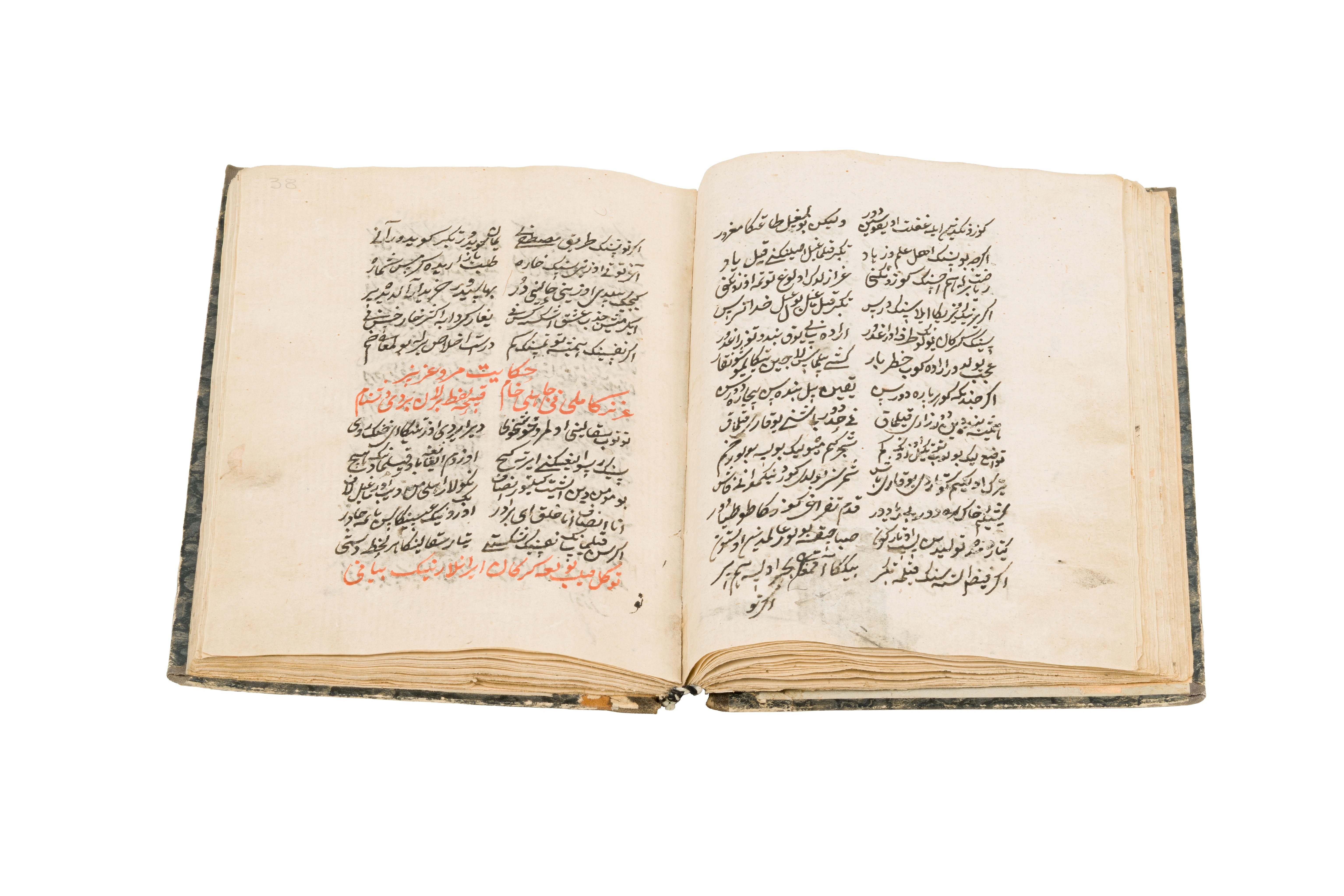
"Sabo ul-Ojizin"
Sufi Olloyor. Calligrapher: Abdusattor ibn Abdullah, 1876. 1690. Bukhara. Uzbek. Nastaliq script. Kokand paper. 13 × 21.5 cm. Manuscript of the Institute of Oriental Studies of the Academy of Sciences of the Republic of Uzbekistan, inv. No. 6887
Description
The small size of this manuscript immediately reveals its practical purpose. It was easy to carry, to use during lessons, or to read while traveling. On the open pages, the rhythmic arrangement of couplets, the red rubricated lines, and the carefully structured layout all suggest a text designed for recitation and memorization.
Sabo ul-ojizin by Sufi Olloyor was far more than a popular Sufi work. In the Emirate of Bukhara and the Khanates of Khiva and Kokand, it served as a compulsory textbook in primary maktab schools. After learning the Arabic alphabet, children memorized these verses, absorbing the foundations of faith, morality, and ethical conduct through poetry.
One of the book’s greatest achievements was its language. Written in the old Uzbek literary tradition, it made Islamic teaching accessible not only to scholars, but also to ordinary people across towns and степpe communities.
For that reason, this modest manuscript became part of the cultural memory of the entire region. Through books like this, the moral and ethical foundations of Central Asian society were shaped over centuries.