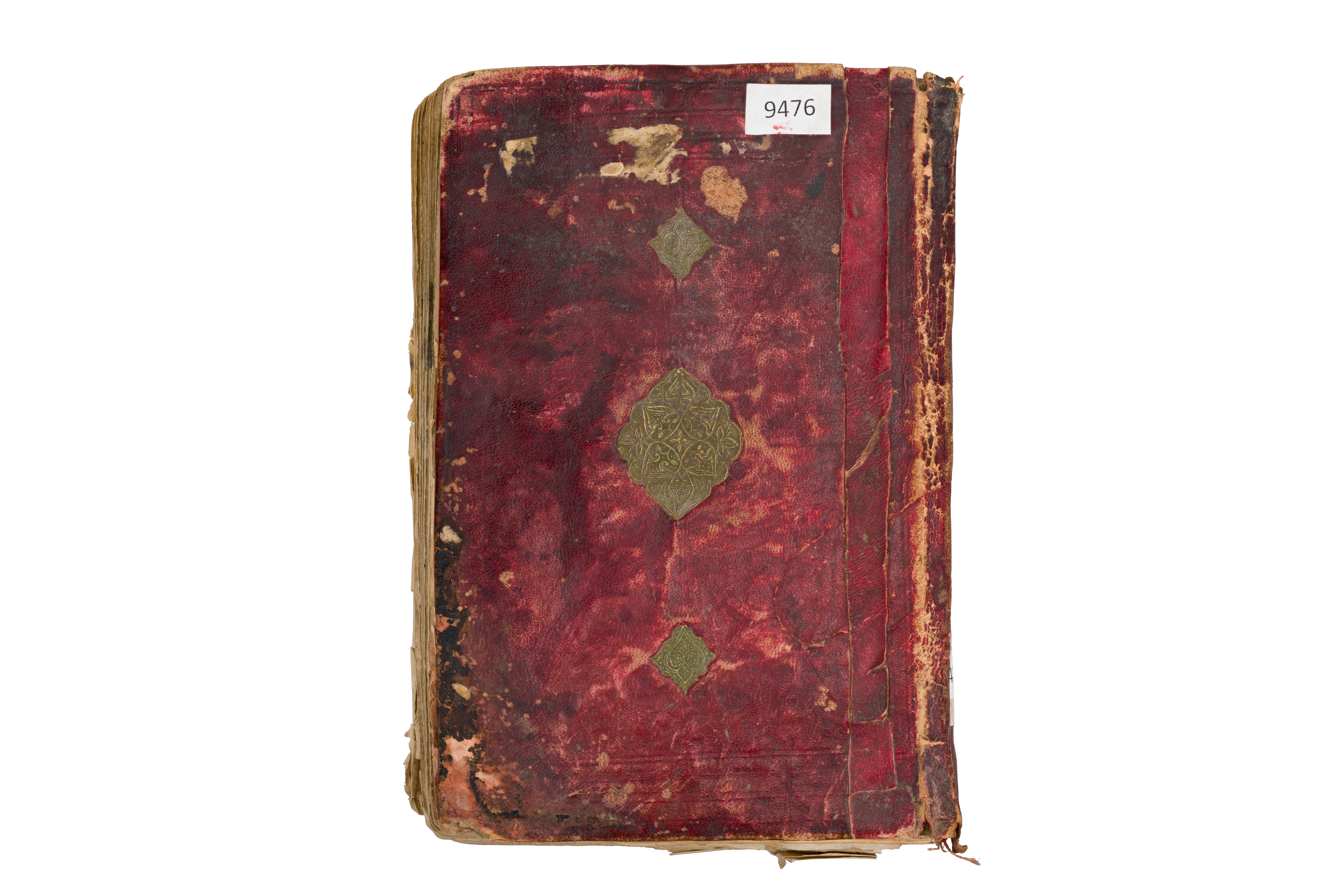
“Fatawa Subhani”
Muhammad Niyaz ibn Abdullah al-Khivaqi. Calligrapher: Muhammad Niyaz al-Khivai, 1840. 1690. Bukhara. Arabic. Nastaliq script. Kokand paper. 29.5 × 20 sm
Description
The margins of this manuscript are almost completely filled with writing. Diagonal notes, dense annotations, and short commentaries surround the main text on every side. This is not a ceremonial book, but a working legal compendium used by generations of scholars and judges.
Fatawa Subhani was compiled in Bukhara at the end of the seventeenth century and became one of the principal collections of legal opinions for Islamic courts in Central Asia. The main text is written in Arabic – the language of classical Islamic jurisprudence – while the numerous marginal notes reflect a living tradition of interpretation and legal debate.
Notice how the calligrapher preserves clarity even in the narrowest spaces of the page. Here, nastaliq script functions not as decoration, but as a precise instrument for transmitting complex legal reasoning.
This manuscript connects Bukhara, Khiva, and the Kokand Valley within a single intellectual network. A text created in Bukhara was copied on Kokand paper by a Khorezmian scribe and remained a practical reference book for qadis and muftis across the region for centuries.