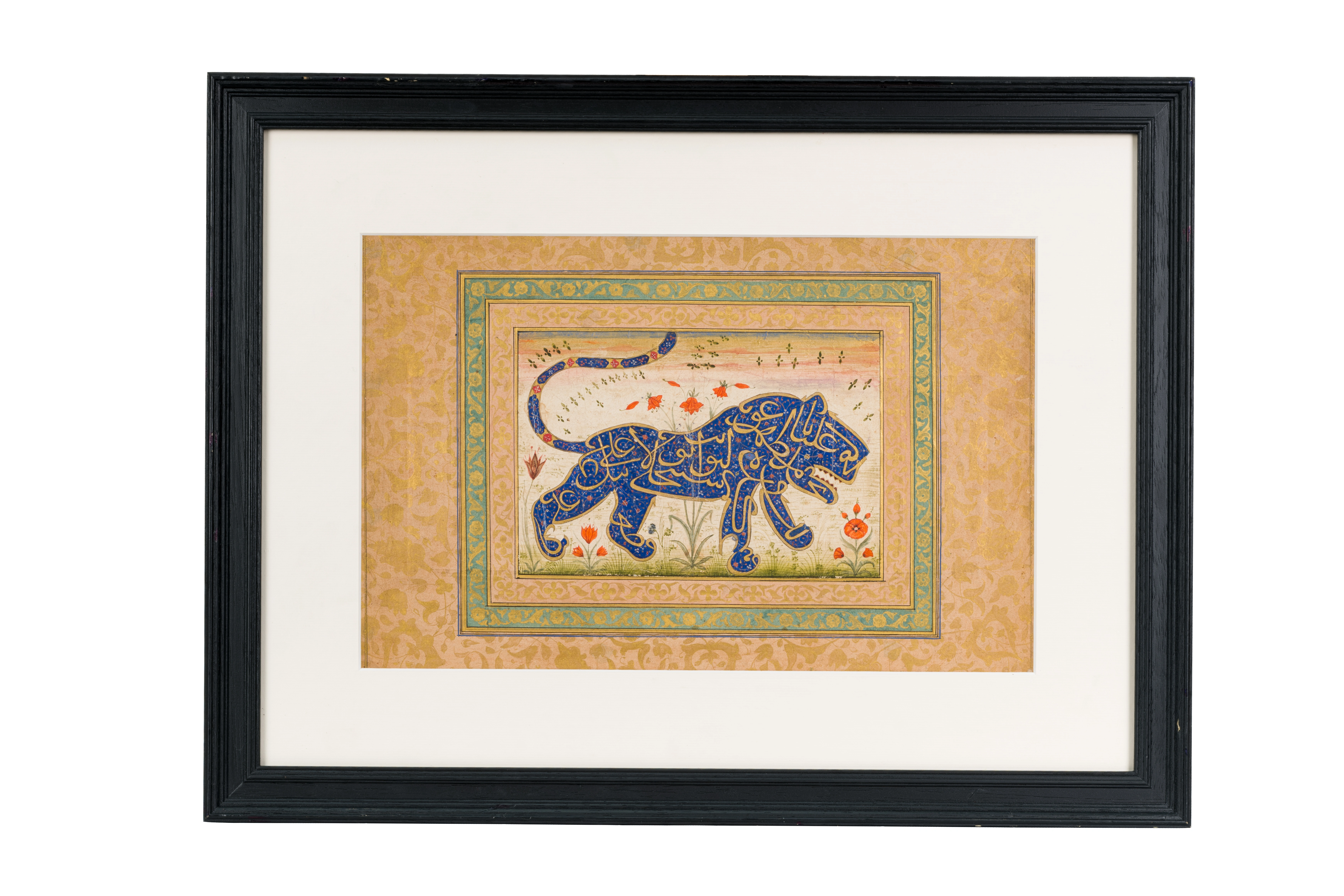
Calligram
In the style of Mir Ali Heravi. 17th century. Herat. Paper; gilded. 23.5 × 36.6 cm
Description
This calligram shows how, in Islamic art, the written word could become an image. At the center of the leaf is the figure of a predatory animal, visually closer to a tiger, formed from flowing lines of Arabic script and emphasized in deep blue with gold accents. In the tradition associated with Mir Ali Heravi, such works required not only beautiful writing, but also precise calculation of form: each letter had to remain readable while also building the silhouette. The reverse side complements the front: it presents a poetic calligraphic panel in nastaliq, surrounded by gilded vegetal and animal motifs. A folio of this kind could have belonged to a muraqqa album, where calligraphy, poetry, and decorated borders were viewed as a single work of art. In the Babur sector, this object is especially meaningful: it connects the Herat school of writing, the Central Asian culture of albums, and the Indian interest in zoomorphic imagery. Before us is not simply a decorated sheet, but a rare example of how the line of writing became an image of authority, protection, and spiritual memory, preserving meaning even when the letter turns into drawing.