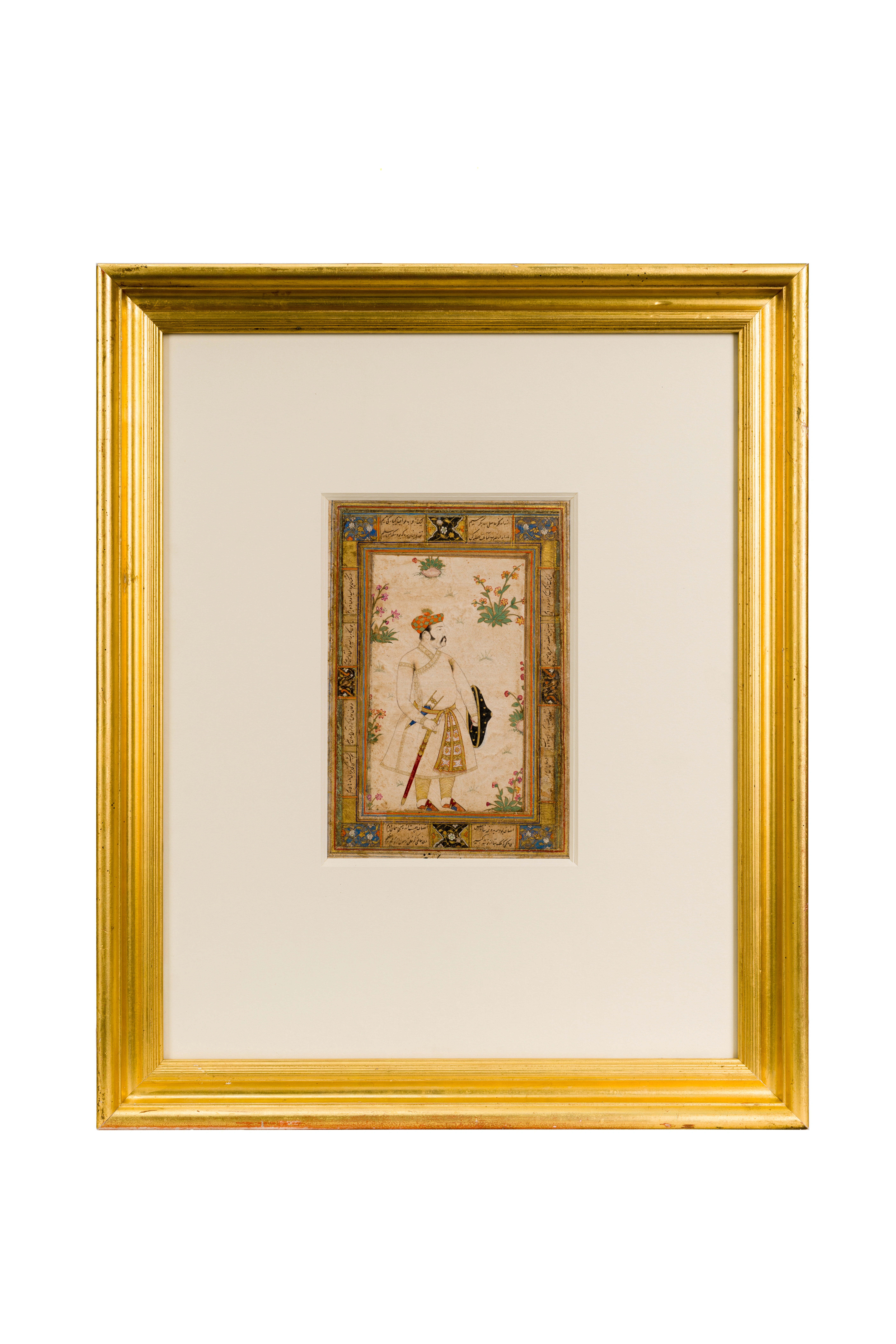
Portrait of Prince Daniyar Mirza, son of Akbar
Late 16th – early 17th century. India. Paper mounted on fabric; tempera. 19 × 12.8 cm
Description
This double-sided folio from the album tradition of muraqqa brings portraiture and calligraphy together. On the front, Prince Daniyar Mirza, son of Emperor Akbar and descendant of Babur, is shown in profile. He wears a pale jama and carries a sword, a dagger, and a dark shield; around him are flowering plants and a decorative border with calligraphic panels. This is not a scene of action, but an image of status: a young member of the dynasty appears as warrior, heir, and participant in courtly culture. The reverse reveals another side of the same world: large lines of nastaliq are set within an ornamental composition with gold and colored fields. Such a folio required from its viewer knowledge of lineage, sensitivity to poetic allusion, and appreciation for the line of writing. In Baburid albums, leaves like this were viewed slowly, comparing the outward dignity of the portrait with the culture of the written word. Its link to the Second Renaissance lies in dynastic memory: the artistic standards of Herat, Samarkand, and Bukhara continued in India, where Babur’s descendants turned portraiture and calligraphy into a language of imperial self-awareness.