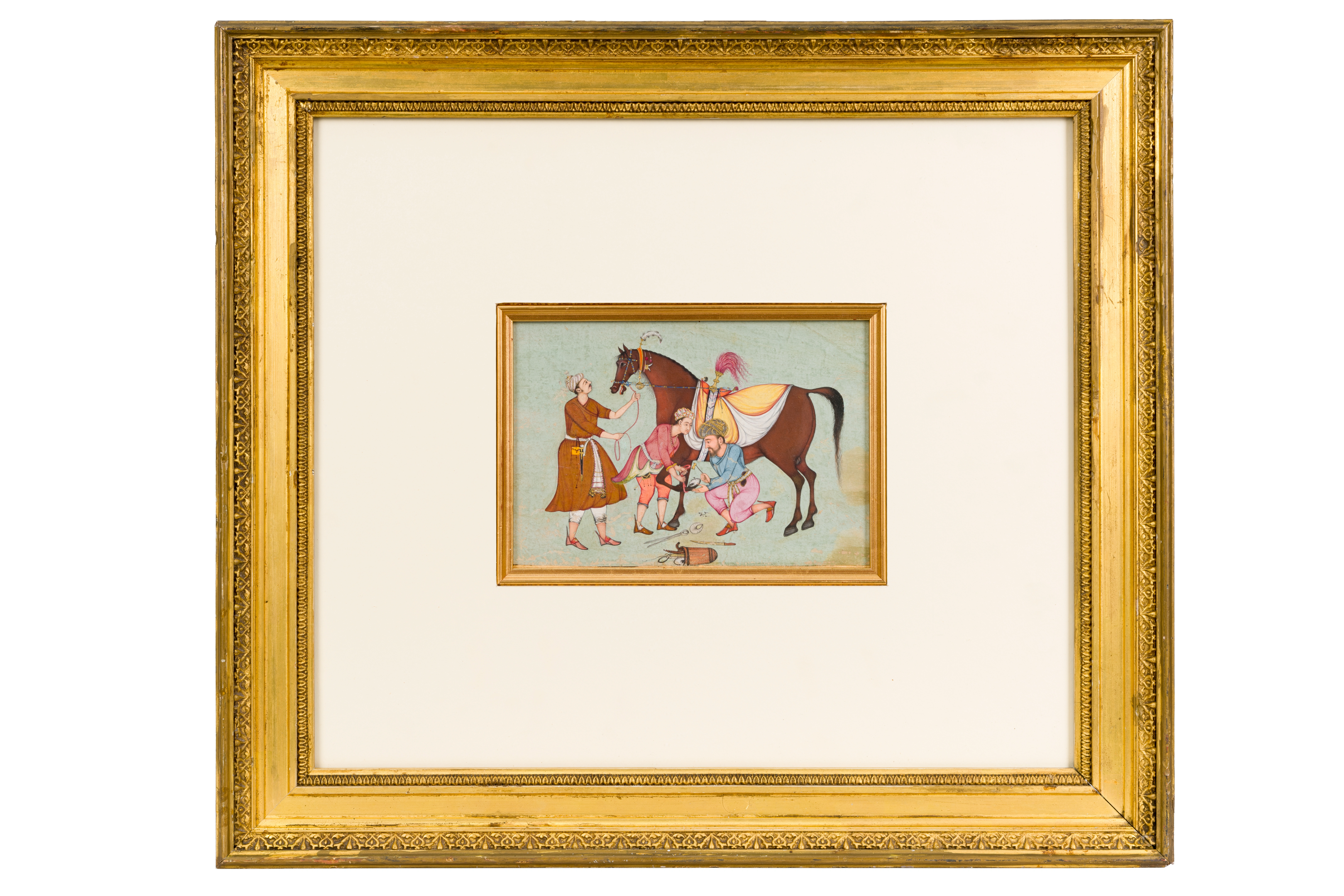
"The Process of Shoeing the King’s horse". Miniature
Late 16th century. India. Paper mounted on fabric; tempera. 12.5 × 18.3 cm
Description
The miniature “Shoeing the Royal Horse” brings us into the space of a Baburid imperial stable in late sixteenth-century India. The artist shows not a ceremonial procession, but precise work around an elite horse: one attendant holds the reins, another carefully lifts the animal’s leg, while the master at the hoof fits the horseshoe; nearby lie tongs, a hammer, and other tools. This everyday detail formed part of a larger state system. In the world of Babur and his descendants, the horse connected the court, the army, the hunt, and diplomatic ritual. Equestrian culture came to India together with the Central Asian traditions of Mawarannahr, but at Akbar’s court it received a new artistic expression – attentive, almost documentary. Early Mughal painting valued observation, gesture, and the exact depiction of craft and daily order. Tempera on cloth-backed paper makes it possible to convey the soft colors of the clothing, the form of the saddle, and the quiet tension of the scene. This view of history is especially appropriate in the Babur sector: here power is revealed not through battle, but through the discipline of care, craft, and knowledge without which imperial cavalry could not exist.