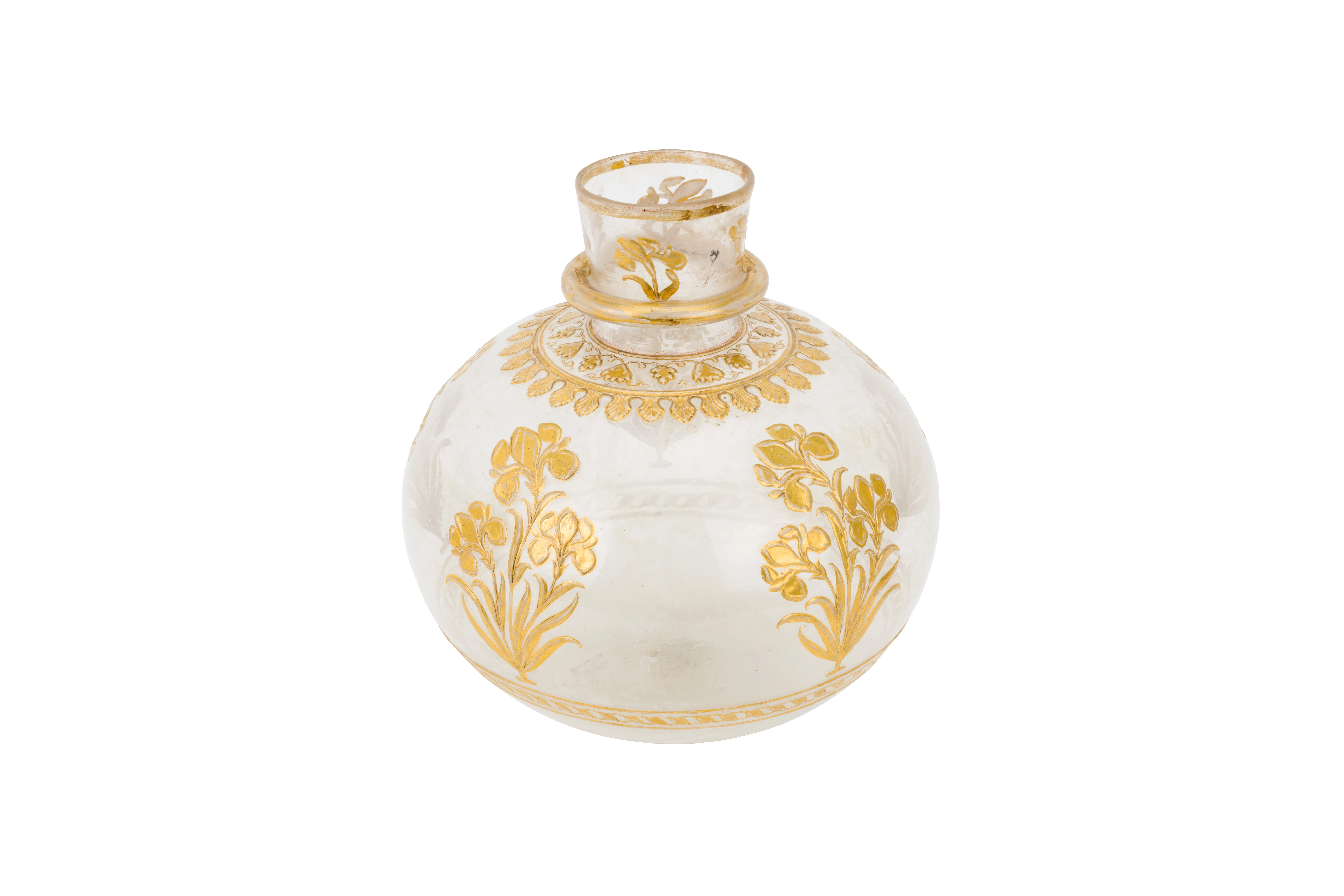
Gilded Vase
Baburid Period. 17th century. India. Glass; gilded. 20 × 20 cm
Audio guide
Description
Notice how light behaves on the surface of this vase. Transparent glass makes the object appear almost weightless, while the gilding anchors the eye and establishes the rhythm of the ornament.
This is an 18th-century CE gilded glass vase from India, dating to the Baburid period. Within the exhibition section “The Second Renaissance” it illustrates cultural connections: artistic traditions shaped in Central Asia and Khurasan continued to develop in new centers, including the Baburid courts. In this context, it is more accurate to speak not of “borrowing,” but of the continuation of a shared artistic language within the broader world of Islamic art.
Observe the vegetal motifs. They are stylized and governed by symmetry. This is not botanical illustration but an ornamental formula—a sign of refined taste and technical skill.
Fine cracks and traces of age are visible on the surface of the vase. For glass, this is particularly significant: a fragile material that preserves the history of its use and handling. This vase reveals another aspect of the period, where technology and aesthetics worked together.