"Ajoyib ut-tabaqot"
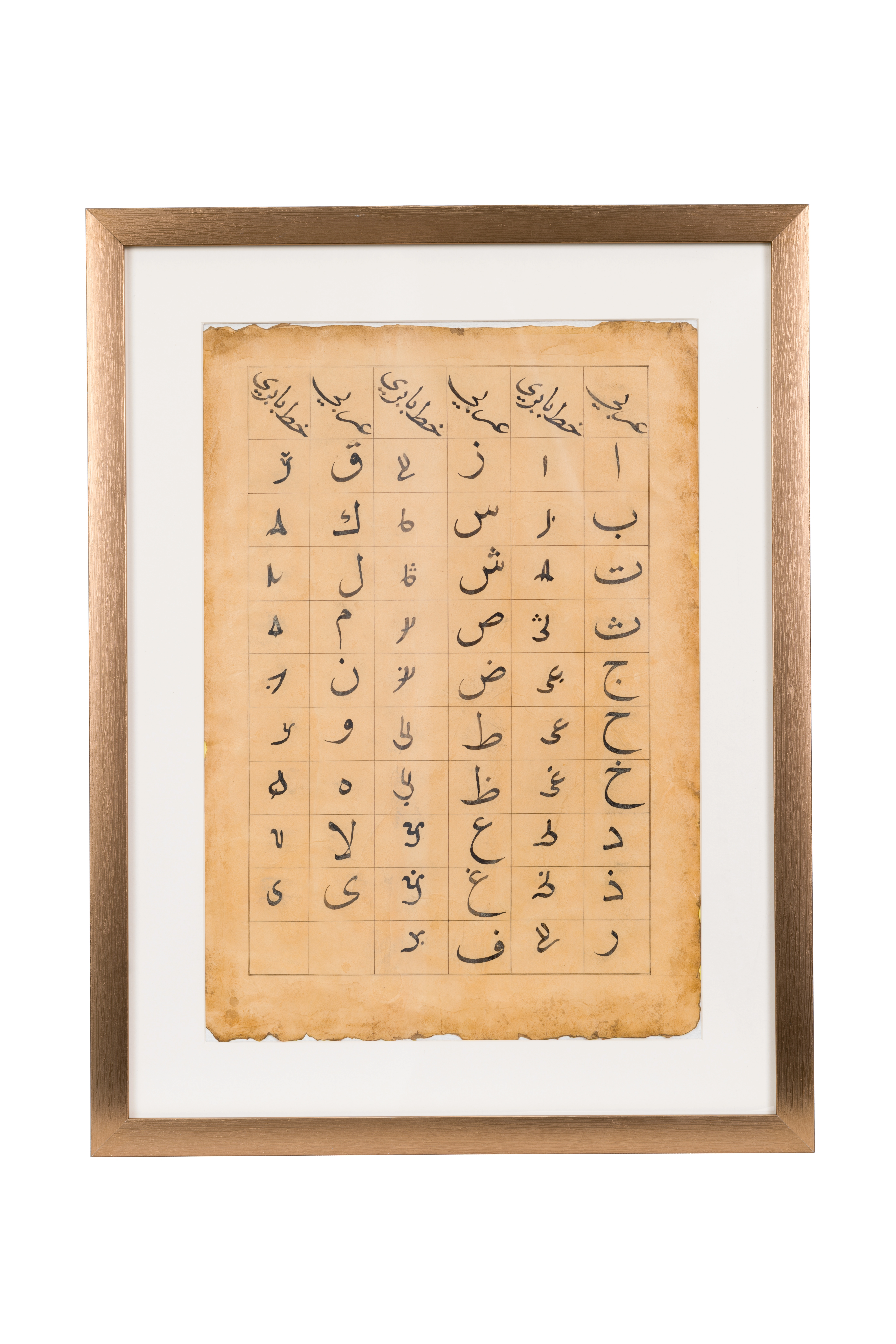
Sample of Baburi script. 1505. Kabul. Uzbek. Paper mounted on fabric; ink. 29 × 42 cm
Description
This folio from “Ajoyib ut-tabaqot” presents a rare example of Khatt-i Baburi, the script created by Zahir al-Din Muhammad Babur in the early sixteenth century. What we see is not an ordinary text, but a comparative table: the headings repeat the terms “Arabic” and “Khatt-i Baburi,” while the rows place Arabic letters beside their graphic equivalents. In this form, the sheet becomes a kind of key for reading a new writing system. Babur, formed within the Turko-Persian manuscript culture of Transoxiana and later established in Kabul, approached writing as a tool of knowledge, governance, and spiritual culture. Khatt-i Baburi is associated with an attempt to simplify Arabic script and to render the sounds of the Turkic language more precisely. Sources also report that a Qur’an, known as the “Baburi Mushaf,” was copied in this script. On the dense paper with a textile base, one can see careful ruling, large isolated signs, and traces of age along the edges. In the Second Renaissance exhibition, this object is important as evidence of Babur’s philological thought: here the ruler appears not only as a conqueror and author of the “Baburnama,” but also as a reformer of the written tradition of the Islamic world.