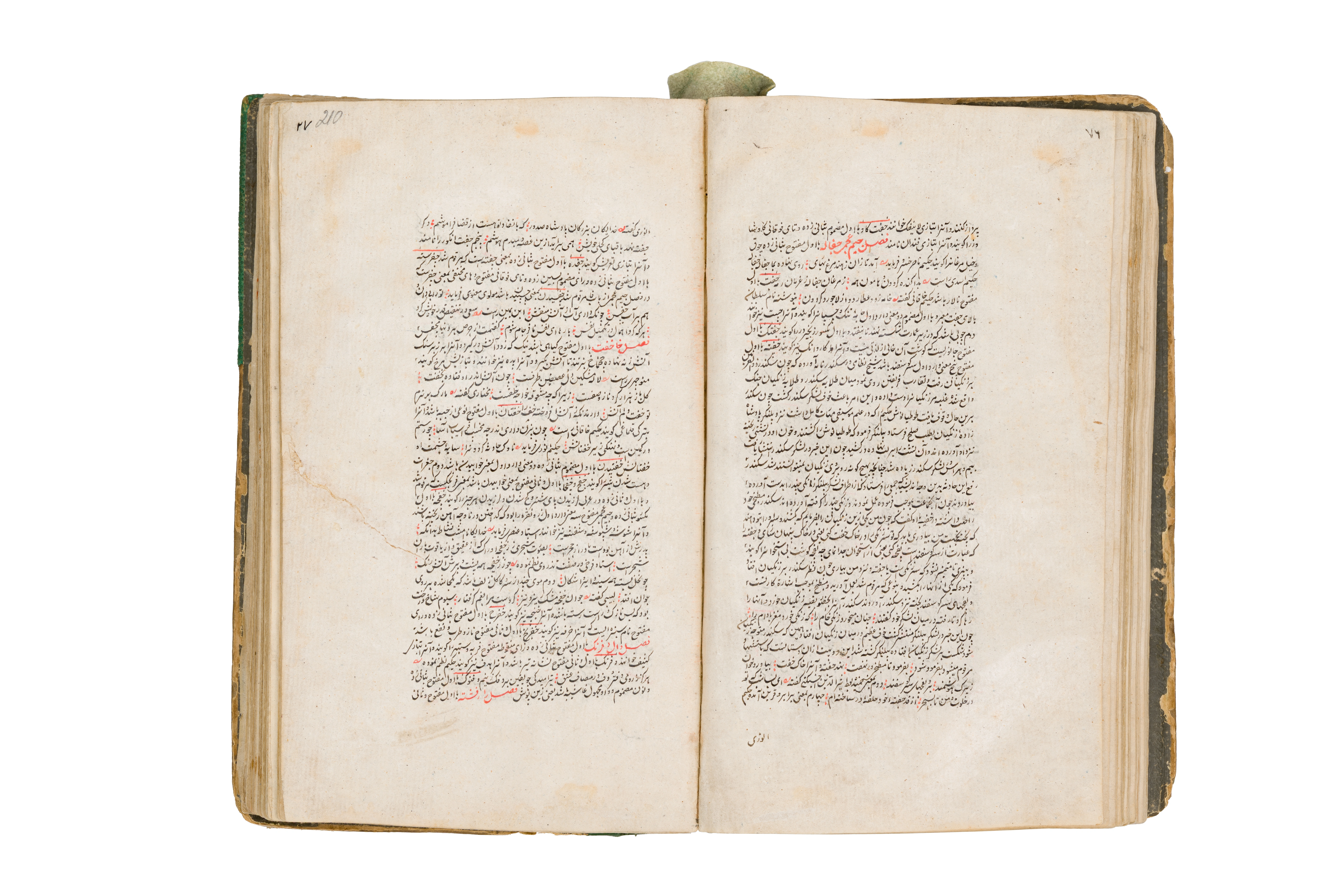
“Farhang-i Jahаngiri”
Hasan Jamal al-Din Ibn Fakhruddin Hussein Inju. Copied in 1859. Iran. Persian. Nastaliq script. Oriental paper. 17 × 30.5 cm. Manuscript of the Institute of Oriental Studies, Academy of Sciences of Uzbekistan
Description
This manuscript introduces us to Persian scholarship as it developed within the intellectual world of the Baburids. The Farhang-i Jahangiri is an explanatory dictionary of classical Persian, compiled by Husayn Inju Shirazi in the early seventeenth century and named in honour of Emperor Jahangir. The copy before us was transcribed in Iran in 1859. Its contents include rare and archaic words, poetic expressions, variant spellings, meanings of terms, and citations from classical poets that confirm the use of each word. On the open pages we see many compact entries: a word, its explanation, grammatical notes, and a literary example form a concise scholarly unit. The book therefore served not only as a reference work, but also as a key to reading literature, chronicles, and learned prose. Dense nasta‘liq script, red rubrication, and the strict organization of the page reveal the work of a professional manuscript workshop. In the context of the Second Renaissance of Islamic civilization, this manuscript is significant as evidence of a cultural bridge between Transoxiana, Iran, and India: Persian united court administration, poetry, history, and scholarship, while Babur’s legacy continued in the multilingual world of his descendants.