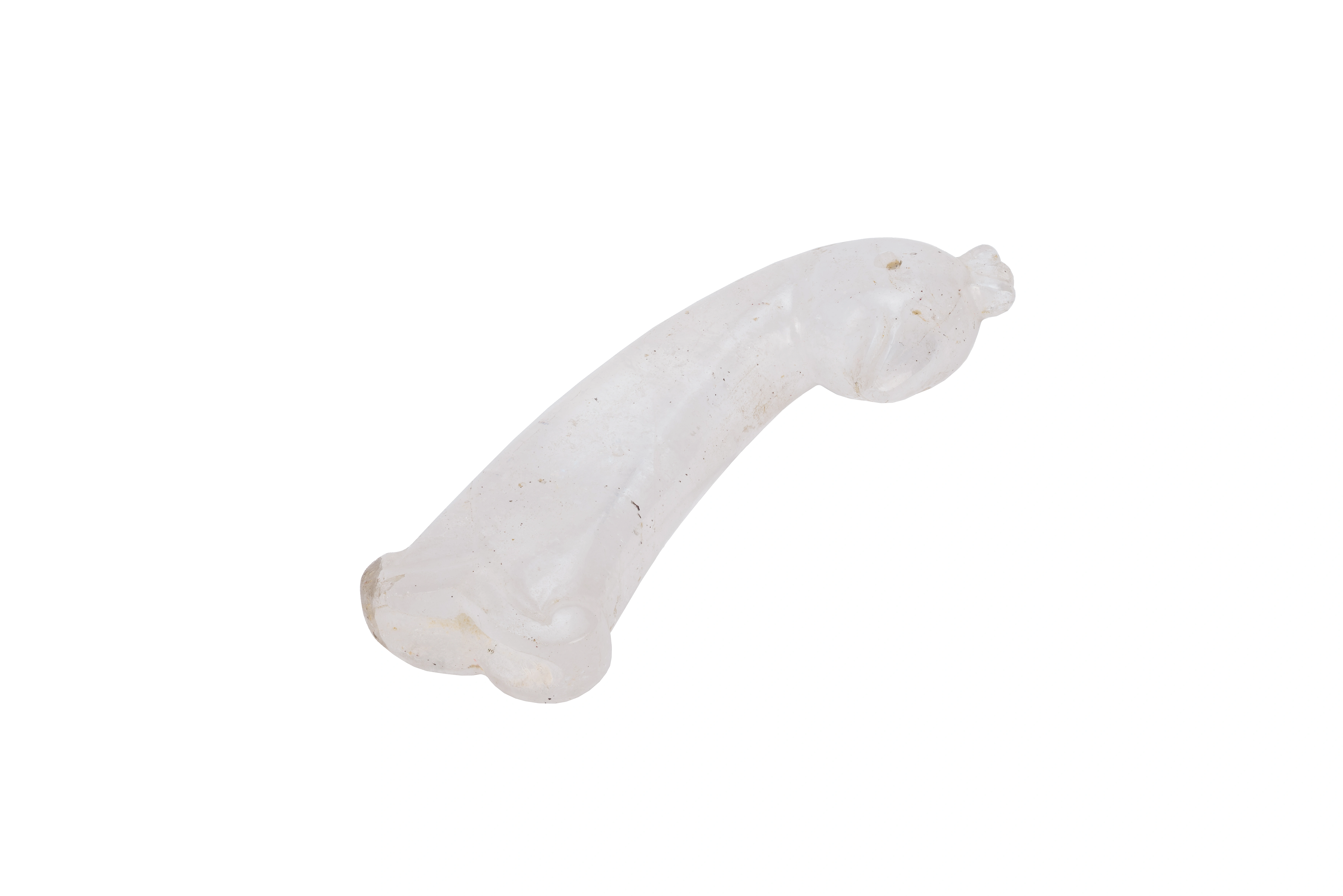
Dagger Hilt
Baburid Period. 17th–18th centuries. India. Nephrite (jade). 10.6 × 4.2 × 2.2 cm
Audio guide
Audio available in: RU
Description
This nephrite (jade) dagger hilt belongs to the flourishing artistic production of Baburid period in the seventeenth and eighteenth centuries, when refinement of form became as important as the intrinsic value of the material.
The choice of pale jade is significant. At the Baburids court, light-colored jade was associated with purity and noble refinement. Unlike the darker green stones favored in earlier Central Asian traditions, milky white jade became a marker of sophisticated aristocratic taste.
The pommel is carved in the form of a stylized animal head. Rather than emphasizing detailed realism, the sculptor relied on simplified contours. This approach reflects a Baburid artistic balance between an interest in natural forms and the Islamic preference for stylized representation.
The ergonomic curvature of the hilt ensured a secure and comfortable grip, while the widened base functioned as a protective stop for the hand.
Jade of this quality was imported into India from the regions of Khotan and Kashgar, demonstrating the integration of the Baburid Empire into long-distance trade networks linking South and Central Asia.
This object illustrates the synthesis of Central Asian heritage, Indian court aesthetics, and technical innovation characteristic of early modern art.