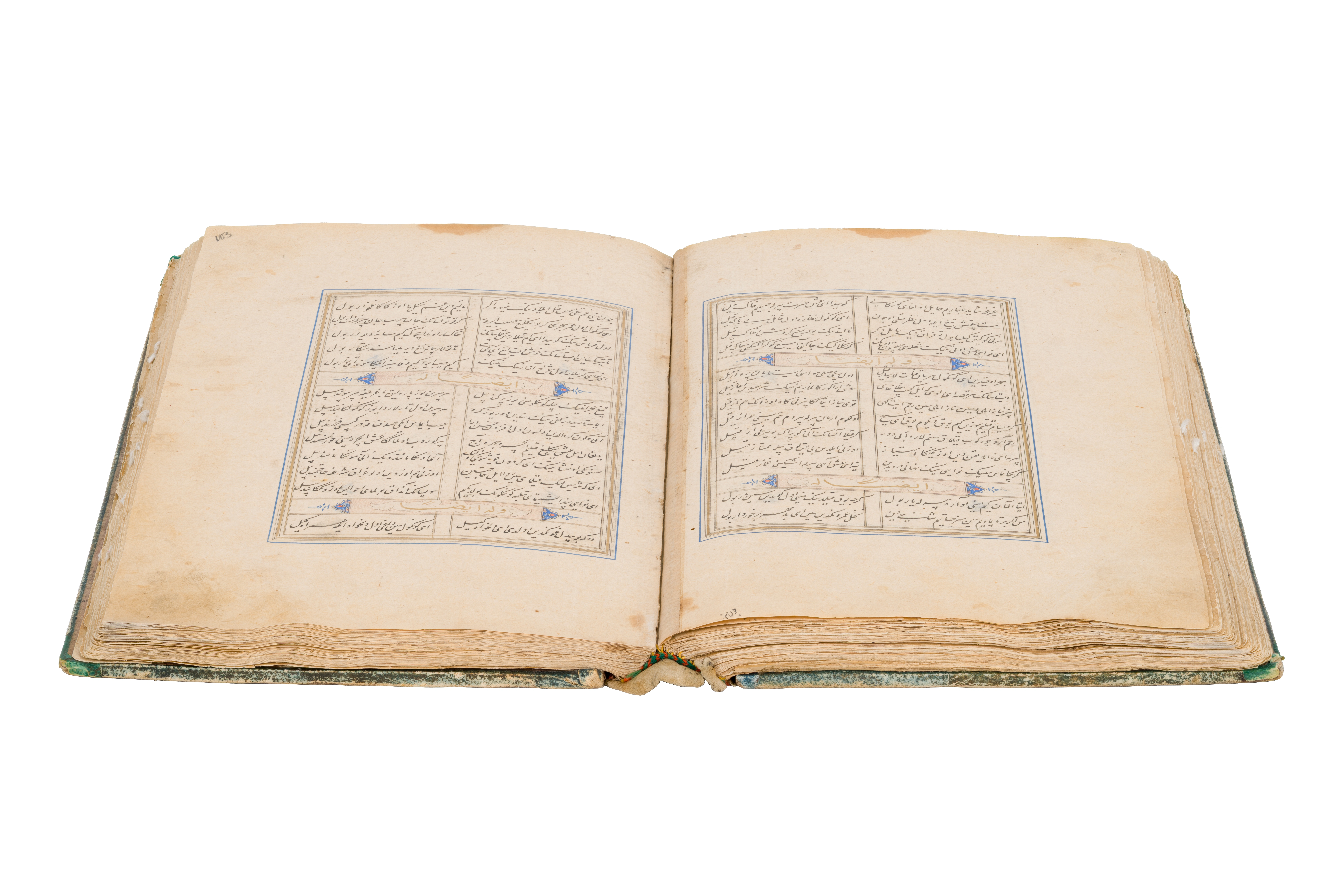
“Ghara'ib al-sighar”
Alisher Navoi. Copied circa late 15th–early 16th century. Turkic. Nastaliq script. Eastern paper. 21 × 15 cm. Manuscript of the Institute of Oriental Studies, Academy of Sciences of Uzbekistan
Description
The compact format of this manuscript changes the scale through which we encounter Navoi: this is not a ceremonial folio, but an intimate book for personal reading. “Ghara’ib al-Sighar,” “The Wonders of Childhood,” is the first divan of the great collection “Khazain al-Ma‘ani,” in which the poet arranged his lyric poetry according to the stages of human life.
This copy was transcribed at the turn of the fifteenth and sixteenth centuries, when Navoi’s language and poetic system were still becoming canonical. Such early manuscripts are therefore especially important for the history of Turkic literary culture in Central Asia.
The text is written in flowing nasta‘liq in two columns. Blue and golden triangular cartouches anchor the corners of the frame, while separate insertions mark transitions between ghazals. The raspberry-red leather binding with a golden shamsa and symmetrical medallions emphasizes the book’s status. Traces of wear show that it was not only preserved, but also read. This manuscript shows how Navoi’s poetry united love lyricism, ethical education, and a culture of refined reading, preserving the intimate voice of youth within the high courtly art of Islamic Central Asia and transmitting it to new generations of readers, students, and poets of the region.