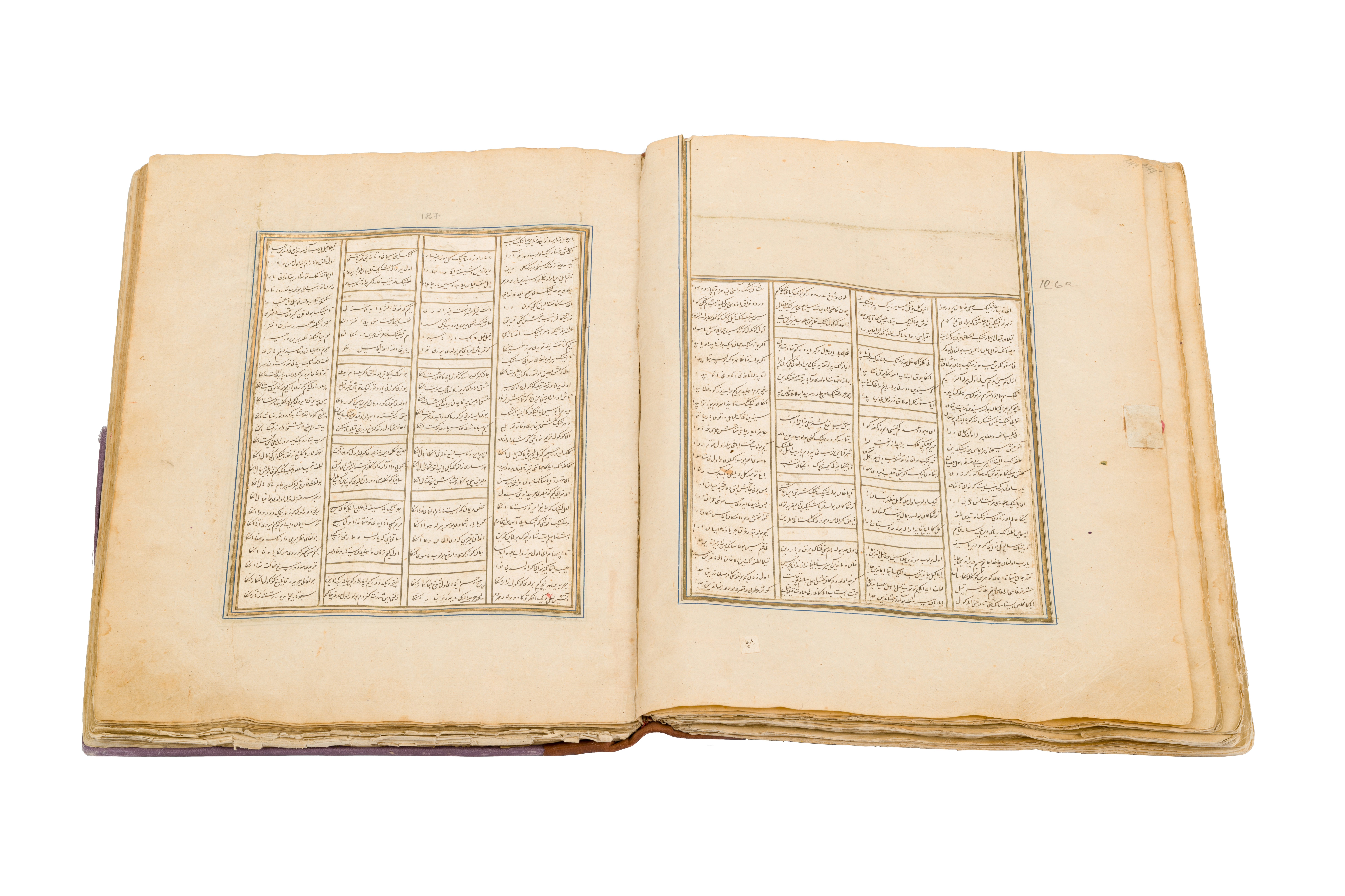
“Khazain al-Ma‘ani”
Alisher Navoi. Copied in late 15th – first half of the 16th century. Central Asia. Turkic. Nastaliq script. Oriental paper. 27 × 38.5 cm. Manuscript of the Institute of Oriental Studies, Academy of Sciences of Uzbekistan
Description
The six-column layout of this manuscript immediately reveals the scale of the project: Navoi’s vast poetic corpus is placed within a strict architecture of line, frame, and margin. “Khazain al-Ma‘ani,” “The Treasuries of Meanings,” is the final collection of his lyric poetry, divided into four divans corresponding to the stages of human life: childhood, youth, maturity, and old age.
This copy was produced in the late fifteenth or first half of the sixteenth century, very close to Navoi’s own age. Such manuscripts are therefore especially important for understanding the early canon of Turkic literature in Central Asia. They show how the poet’s legacy quickly became a cultural norm after the transition from the Timurids to the Shaybanids.
The large format, eastern paper, and fine ruling indicate the ceremonial character of the book. The worn leather binding with a large shamsa and traces of repair speaks of long reading and preservation. This manuscript unites Turkic poetry, courtly calligraphy, and the memory of Navoi as a foundation of Mawarannahr’s intellectual culture. Each folio expresses the idea of the book as an ordered space of meaning, memory, authorial dignity, and cultural continuity.