“Divan-i Husayni”
Husayn Bayqara. Turkic. Nastaliq script. 23 × 16 сm. Facsimile
Description
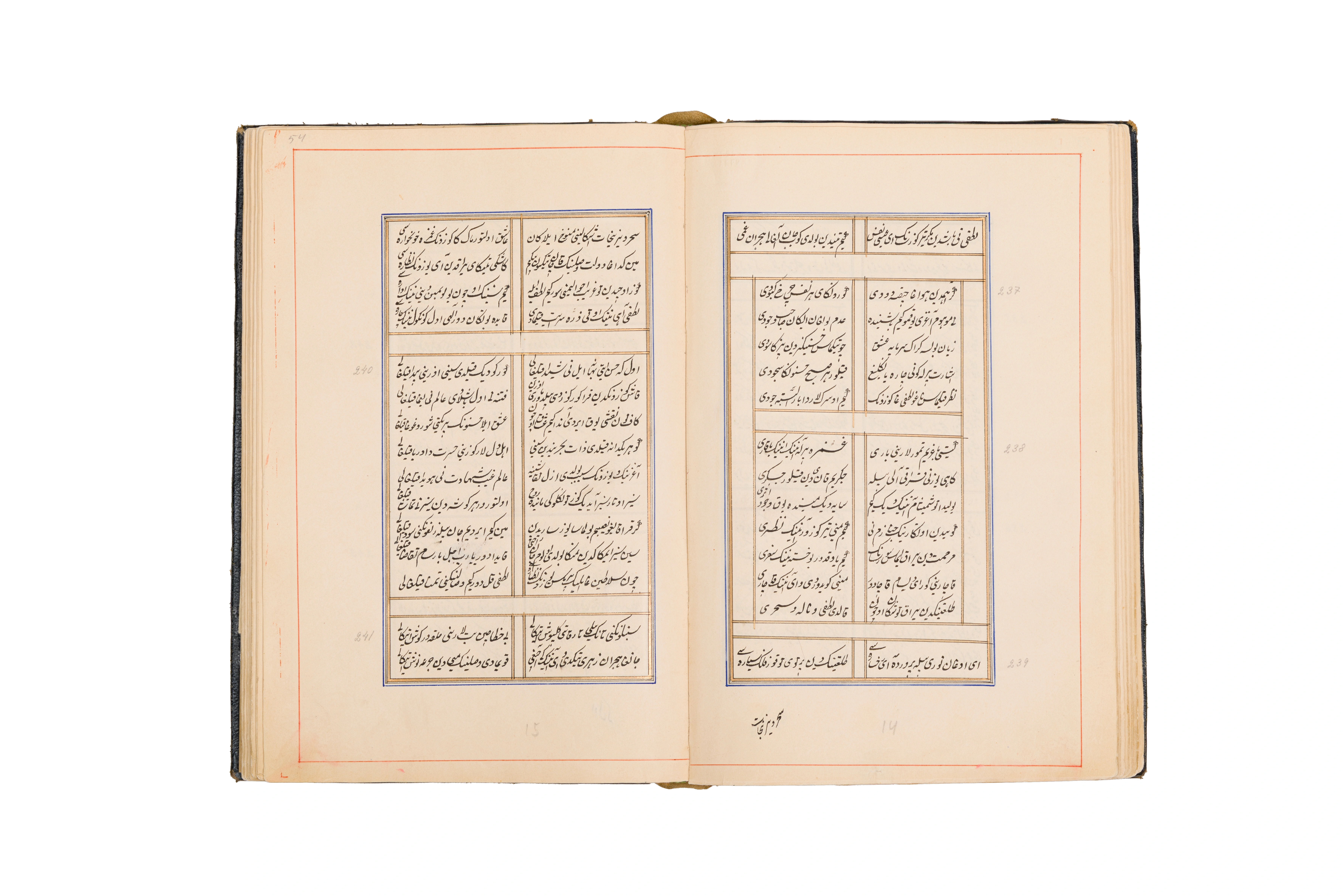
The black leather binding with red medallions and the opening with two-column nastaliq script remind us that this is a facsimile not of an ordinary collection of poems, but of a courtly divan by a ruler-poet. “Divan-i Husayni” belongs to Sultan Husayn Bayqara, the last great Timurid ruler of Khurasan and patron of Alisher Navoi.
Husayn wrote ghazals in Turkic under the poetic name Husayni. In his poetry, the theme of love is joined with ethical reflection and Sufi imagery. The divan is therefore important not only as a literary monument, but also as evidence that Turkic poetry achieved high artistic status at the court of Herat.
The facsimile accurately reproduces the manuscript’s structure: golden frames, a separate field with the formula “Bismillah,” carefully arranged text blocks, and traces of the original’s use. Through this exhibit we see Husayn Bayqara’s kitabkhana – an environment where poetry, calligraphy, power, and patronage of learning created a shared language of late Timurid culture, while the book became at once an artistic object, a political sign, and a means of preserving the memory of Navoi’s circle for many later generations of readers in Central Asia and the Islamic East.