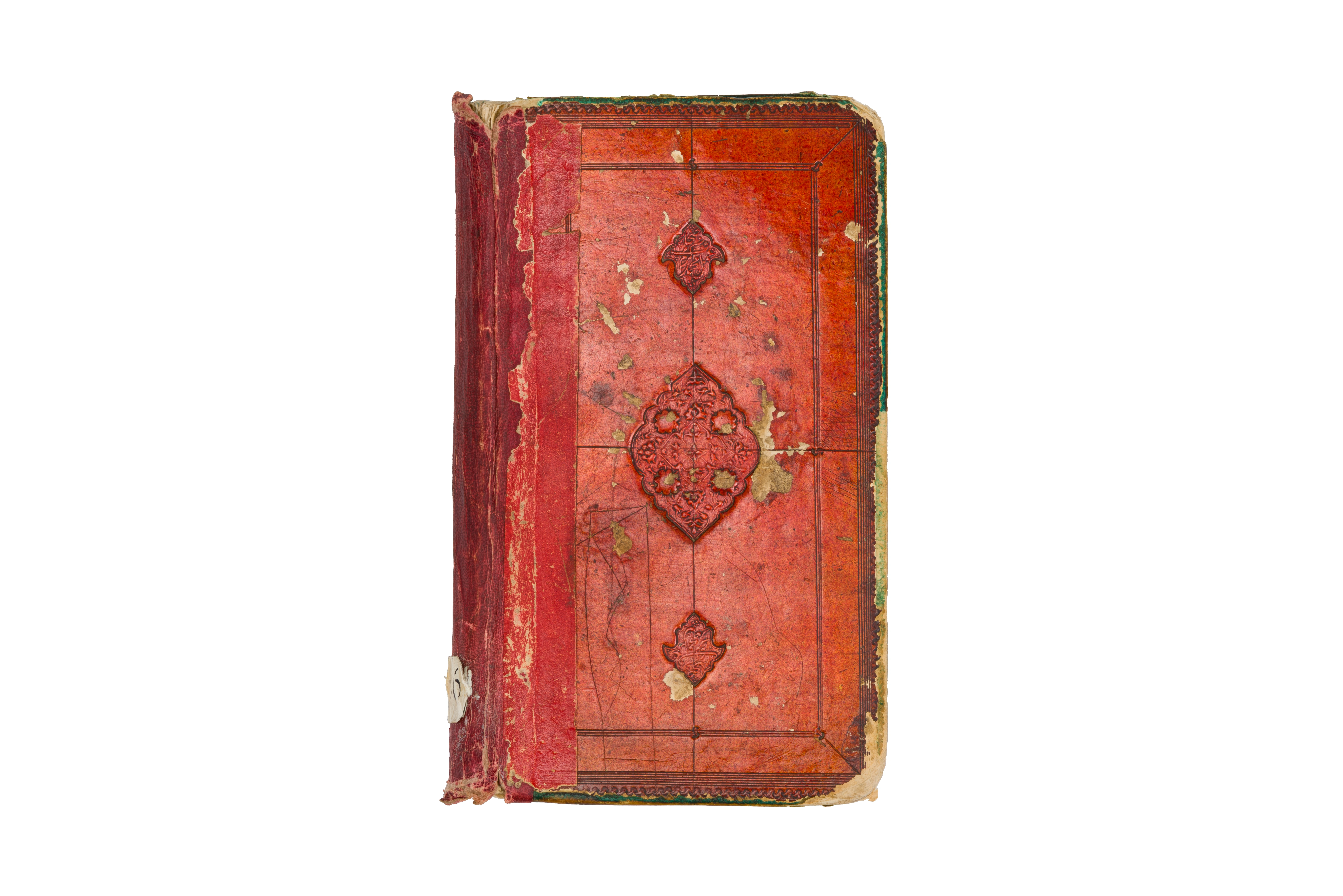
“Risala-i Duvazdah Maqam”
Najm al-Din Kawkabi. Copied in 1848. Persian. Nastaliq script. Oriental paper. 15 × 26 cm.. Manuscript of the Institute of Oriental Studies, Academy of Sciences of Uzbekistan
Description
This manuscript is devoted to one of the most refined intellectual arts of the Islamic East – the theory of music. The treatise Risala-i Duvazdah Maqam presents the sophisticated system of the twelve maqams not in dry scholarly prose, but through elegant poetic language.
Its author, Najm al-Din Kawkabi Bukhari, was a renowned sixteenth-century musician, poet, and theorist. His work became an important part of the intellectual tradition of Mawarannahr and later influenced the development of Central Asia’s classical musical heritage, including the Shashmaqom tradition.
Copied in 1848, this manuscript reflects the high standards of late Bukharan book culture. The text is written in graceful nasta‘liq script, considered the pinnacle of Islamic calligraphic aesthetics. The carefully structured columns and emphasized headings allowed musicians and scholars to navigate the theoretical material with ease.
The leather binding, decorated with an embossed central medallion known as a turunj, further emphasizes the manuscript’s prestige. Such bindings were reserved for valuable scholarly and literary works.
In the intellectual culture of the Islamic world, music theory was closely connected with mathematics, astronomy, and philosophy. The twelve maqams were associated with planetary motion, zodiac signs, and cosmic order. Manuscripts like this were therefore understood not merely as musical manuals, but as reflections of universal harmony itself.