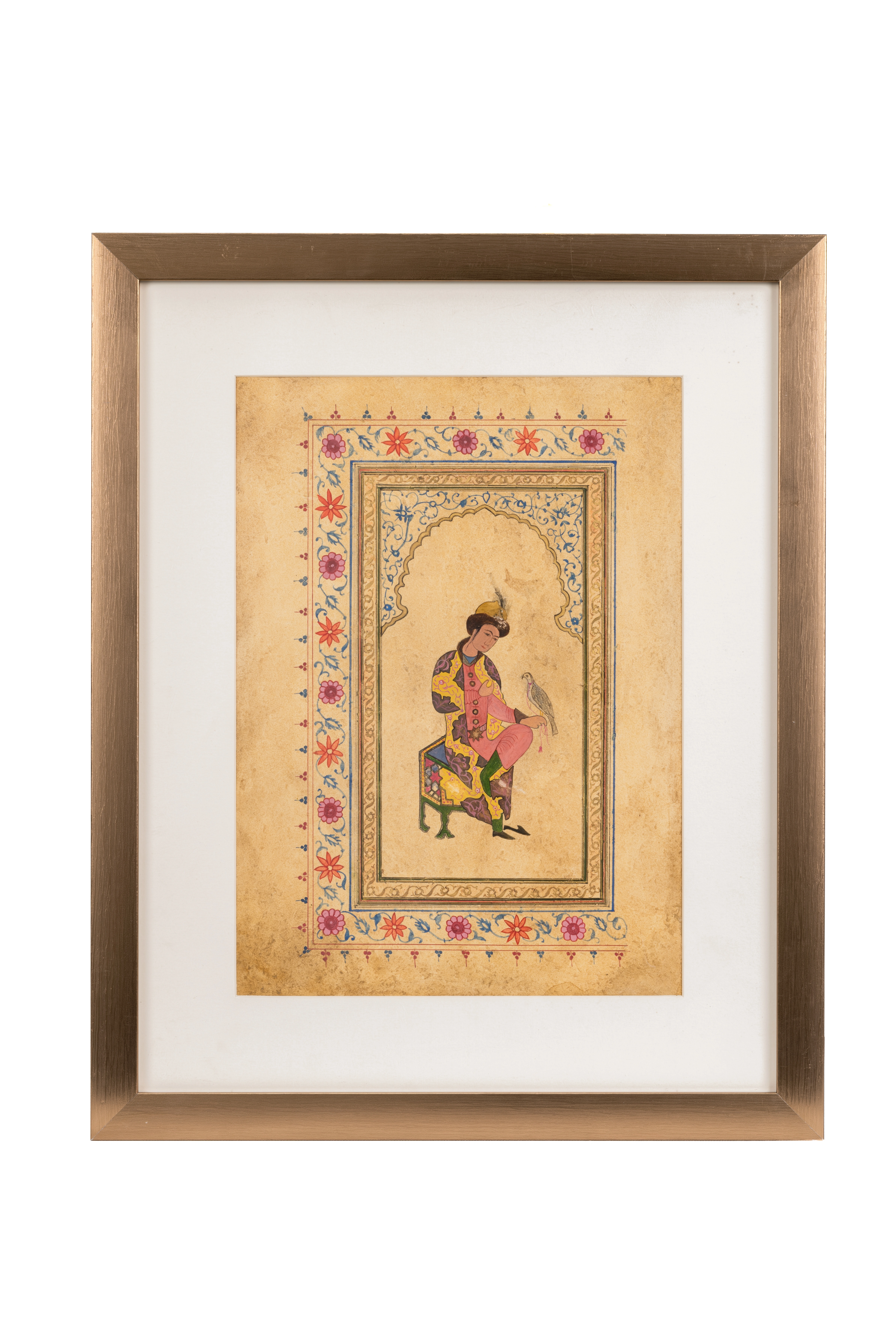
“The youth with the falcon”
Miniature to “Flower and Nowruz” by Khoja Kirman. 16th century. Central Asia. Paper. 28.5 × 20.5 cm
Description
This is an elegant sixteenth-century miniature depicting a young nobleman holding a falcon. The painting was created as an illustration to Khoja Kirmani’s poetic work Flowers and Nowruz. Such scenes were highly valued in the courtly culture of Central Asia, where poetry, painting, and philosophy formed a unified artistic language.
The youth is shown in a moment of quiet contemplation. His figure is framed within a delicate arched niche resembling a pavilion in a paradise garden. By isolating the figure from the outside world, the artist creates an atmosphere of introspection and poetic melancholy.
The falcon carries profound symbolic meaning. In the culture of the Islamic East, it represented not only nobility and royal authority, but also, in Sufi poetry, the human soul striving for spiritual freedom and transcendence.
The miniature is distinguished by its refined color harmony. The golden-yellow robe, vivid pink garments, and green boots reflect the decorative brilliance characteristic of sixteenth-century Central Asian painting. Yet despite its rich palette, the composition remains intimate and restrained.
The illuminated floral border, known as a hashiya, symbolizes the garden of Paradise, eternal spring, and cosmic harmony – central concepts in the artistic imagination of the Timurid and Shaybanid eras.