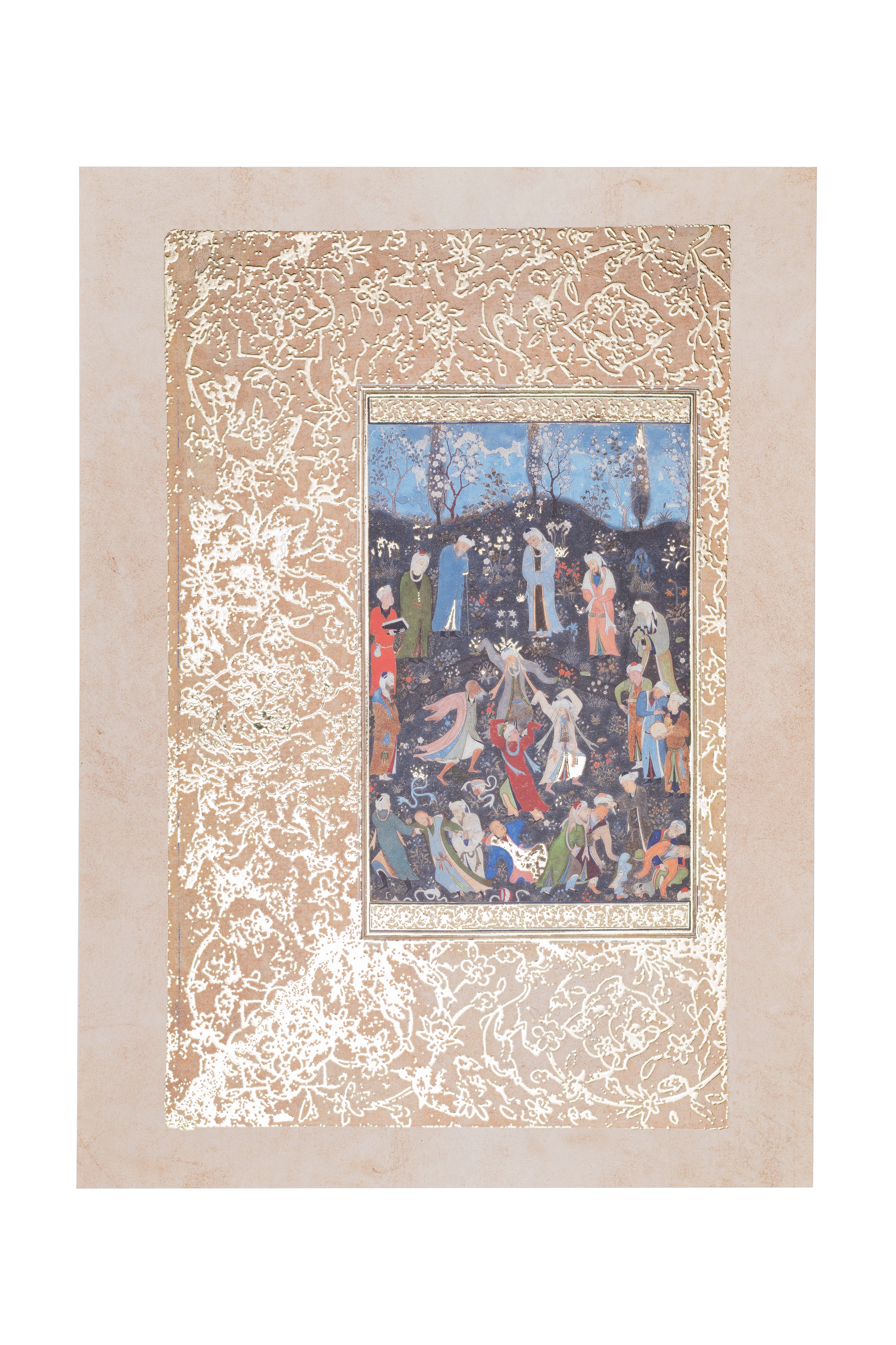
“Sufi Dance (Jami, Navoi, Behzod, etc.)”. Miniature
Kamal al-Din Behzad. 1490. Paper. 31.7 × 19.7 cm. Facsimile
Description
In this miniature, movement itself becomes the language of art. Kamal al-Din Behzad depicts the Sufi ritual of sama – the sacred whirling of dervishes performed in search of spiritual union with the Divine.
The composition unfolds like a living vortex. At the center, the dancers seem almost weightless: their robes expand in motion, their hands rise upward, and their heads tilt back in ecstasy. Around them stand musicians, spectators, and spiritual elders. On the right, performers play the daf and the ney, whose rhythmic sound guided participants into mystical trance.
Yet Behzad avoids disorder. Every figure is governed by precise linear rhythm and carefully balanced color. The dark garden scattered with white blossoms, slender cypresses, and luminous blue sky evoke a symbolic vision of paradise revealed to the mystic during dhikr.
The miniature reflects the intellectual atmosphere of late fifteenth-century Herat, where Sultan Husayn Bayqara’s court gathered figures such as Alisher Navoi, Abd al-Rahman Jami, and Behzad himself. In this environment, Sufism shaped not only religious life, but also poetry, philosophy, and artistic thought.
The gilded floral decoration surrounding the image transforms the miniature into a sacred visual space. Here, the art of the Timurid Renaissance unites manuscript culture, music, mysticism, and visual harmony into a single expression of Islamic civilization in Central Asia.