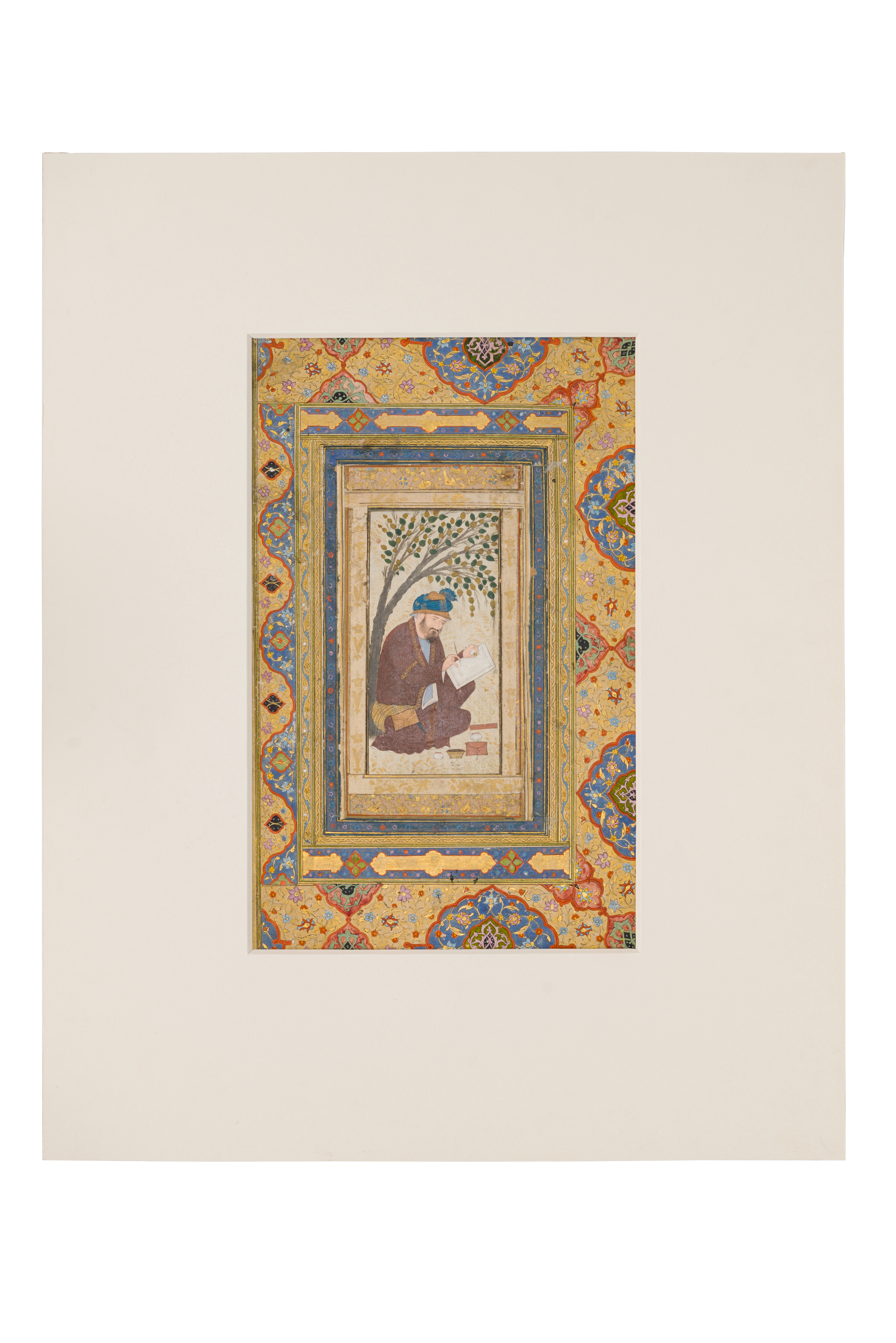
Artist’s portrait
In the style of Reza Abbasi’s miniatures. 17th century. Khorasan. Fabric mounted on paper; tempera. 30.5 × 19.2 cmFrame: 53.2 × 43.3 cm
Description
In this miniature, the expressive power of painting is concentrated in the elegance of line. Created in the style of Reza Abbasi during the seventeenth century, the work depicts an artist or calligrapher absorbed in the act of creation – a rare subject in Islamic art, where the maker of the manuscript itself becomes the central figure.
Seated beneath a tree, the figure occupies a quiet space of contemplation. A sheet of paper rests on his knees, while writing tools and an inkpot lie nearby. Such solitary scenes became especially popular in the later Safavid period, when artists increasingly explored themes of introspection, scholarship, and spiritual reflection.
The composition is deliberately restrained. Rather than constructing a crowded narrative, the painter focuses on the rhythm of contour lines, the softness of drapery, and the graceful curve of the branches above the figure. This refined linearity became one of the defining features of the artistic language associated with Reza Abbasi.
The richly ornamented border, or hashiya, frames the image with gold arabesques and blue-red medallions, transforming the page into a precious object. In Islamic manuscript culture, such decoration elevated the book beyond a literary artifact into a vessel of intellectual and spiritual prestige.
The image of the solitary artist reflects the broader intellectual atmosphere that connected Khurasan, Herat, and the literary circle of Alisher Navoi – a world in which the arts of writing and painting were understood as paths toward inner refinement.