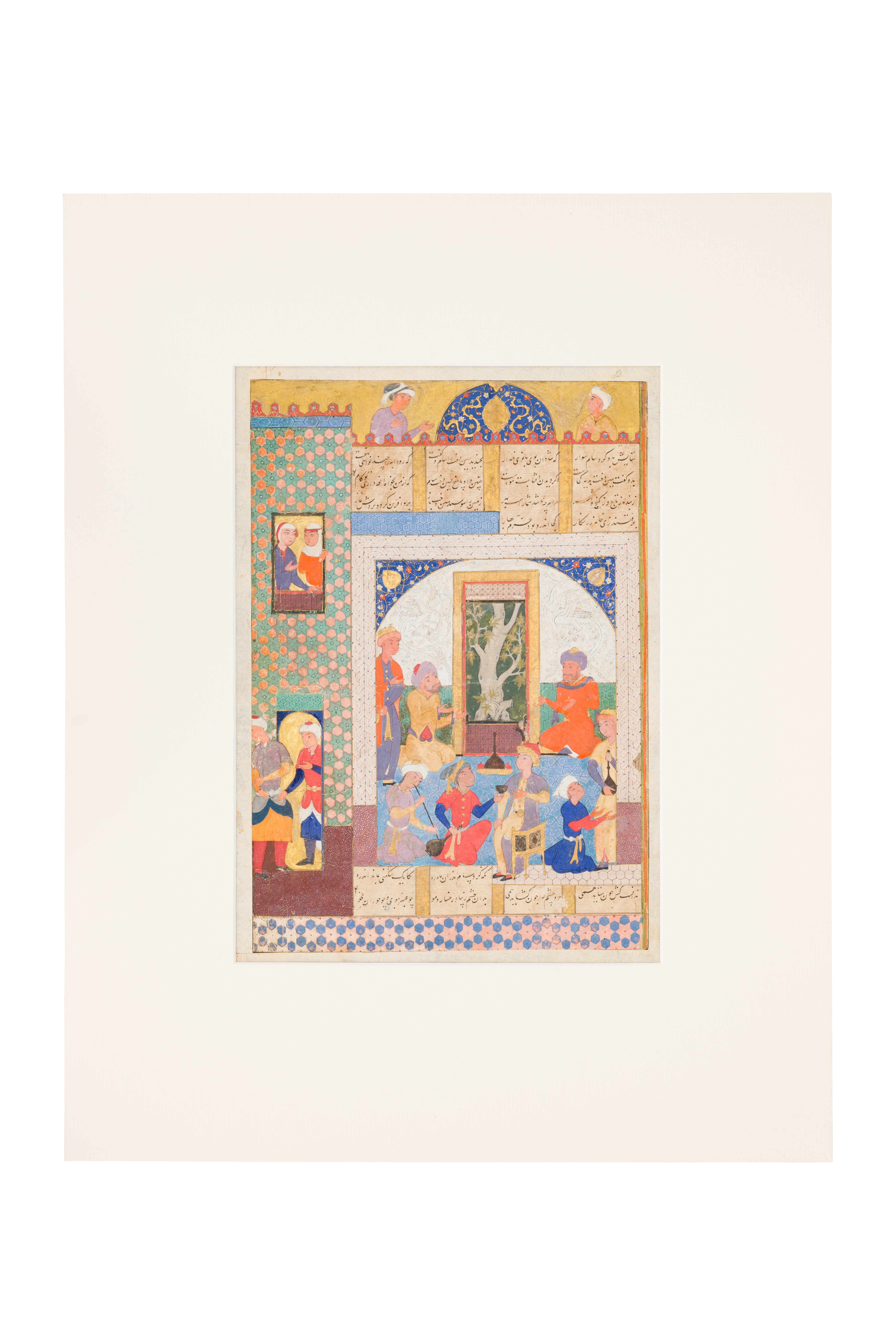
Miniature
Late 16th century. Mashhad. Paper; gilded, tempera. 28.5 × 20.4 cm. Frame: 49 × 39.5 cm
Audio guide
Description
This miniature, created in Mashhad in the late sixteenth century, reflects a transitional period in the art of the Islamic world. During this time, manuscript painting increasingly shifted from epic historical narratives toward more intimate scenes of intellectual and courtly life.
The scene likely represents a gathering of noblemen, poets, or scholars engaged in conversation and refined leisure. Such imagery reflects the cultural ideal of an educated elite, where poetry, philosophy, and music formed the foundation of courtly identity.
The architectural setting is particularly significant. The walls are decorated with intricate geometric patterns known as girih. In Islamic visual culture, these patterns symbolized cosmic order and the unity underlying creation.
A notable artistic device is the framed opening at the center, revealing a flowering tree. This “image within an image” often symbolized the relationship between the visible world and the inner spiritual reality.
This miniature illustrates how, by the late sixteenth century, Islamic painting increasingly sought to express mood and intellectual atmosphere rather than specific historical events.