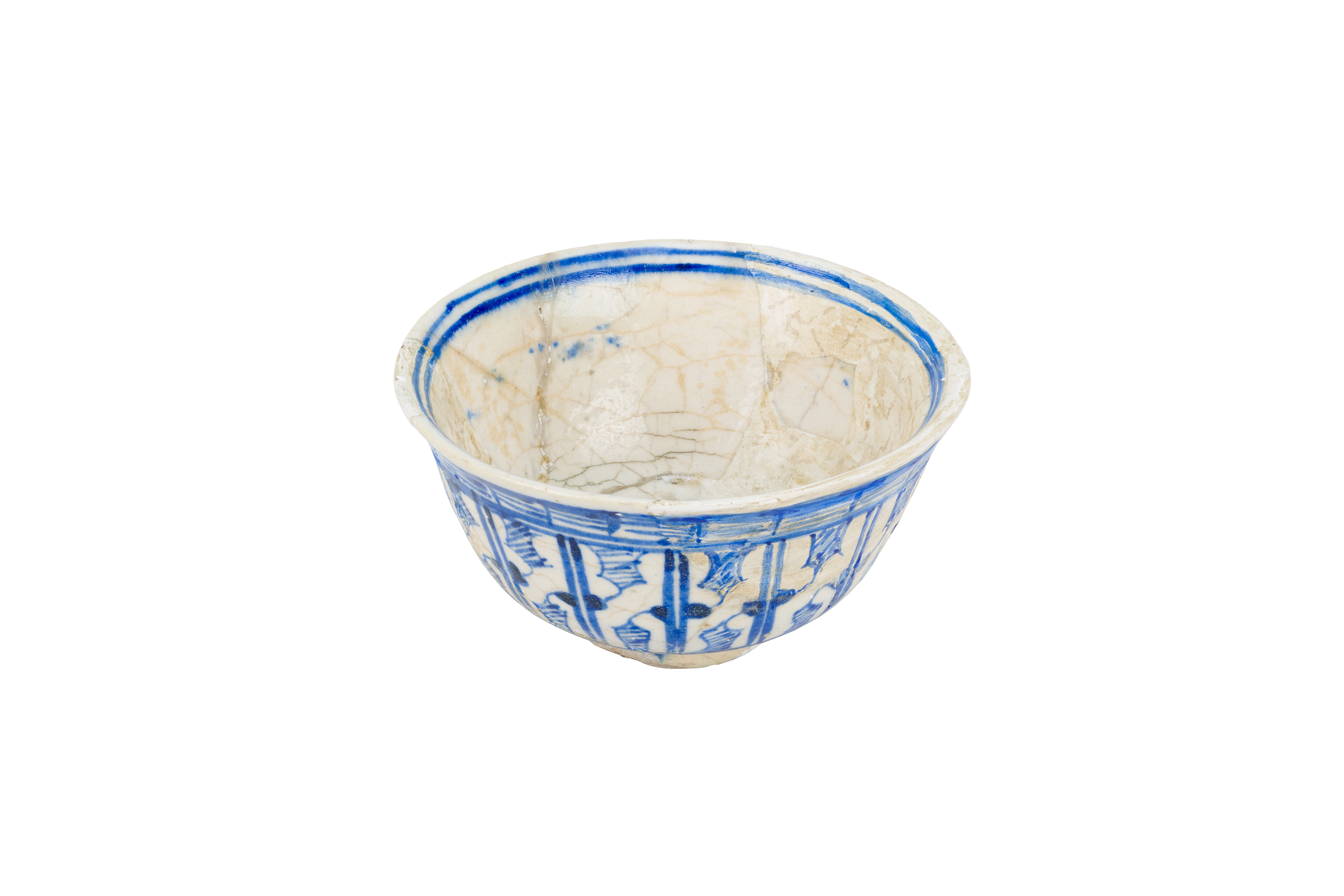
Piala (Small Bowl)
15th century. Tashkent. Ceramic; engobe, decorated with cobalt pattern. 5.6 × 11.6 cm. WOSCU collection
Description
This small fifteenth-century bowl from Tashkent provides insight into the everyday material culture of the Timurid period. Despite its modest size, it reflects the artistic, commercial, and intellectual networks of its time.
Its shape corresponds to vessels used for tea and herbal infusions.
The exterior decoration represents a simplified version of geometric girih patterns commonly used in Islamic architecture. Their transfer onto ceramics reflects the artisans’ interest in expressing concepts of harmony and mathematical order.
The fine network of cracks visible inside the bowl resulted naturally from the firing process. Such surface effects were not considered defects but rather signs of material authenticity and traditional craftsmanship.
The cobalt decoration further indicates the region’s long-distance trade connections, as high-quality cobalt pigments often arrived through commercial exchanges with Iran.
This object demonstrates how even a simple household vessel could embody the aesthetic ideals, scientific outlook, and cultural values of the age of Timurids.