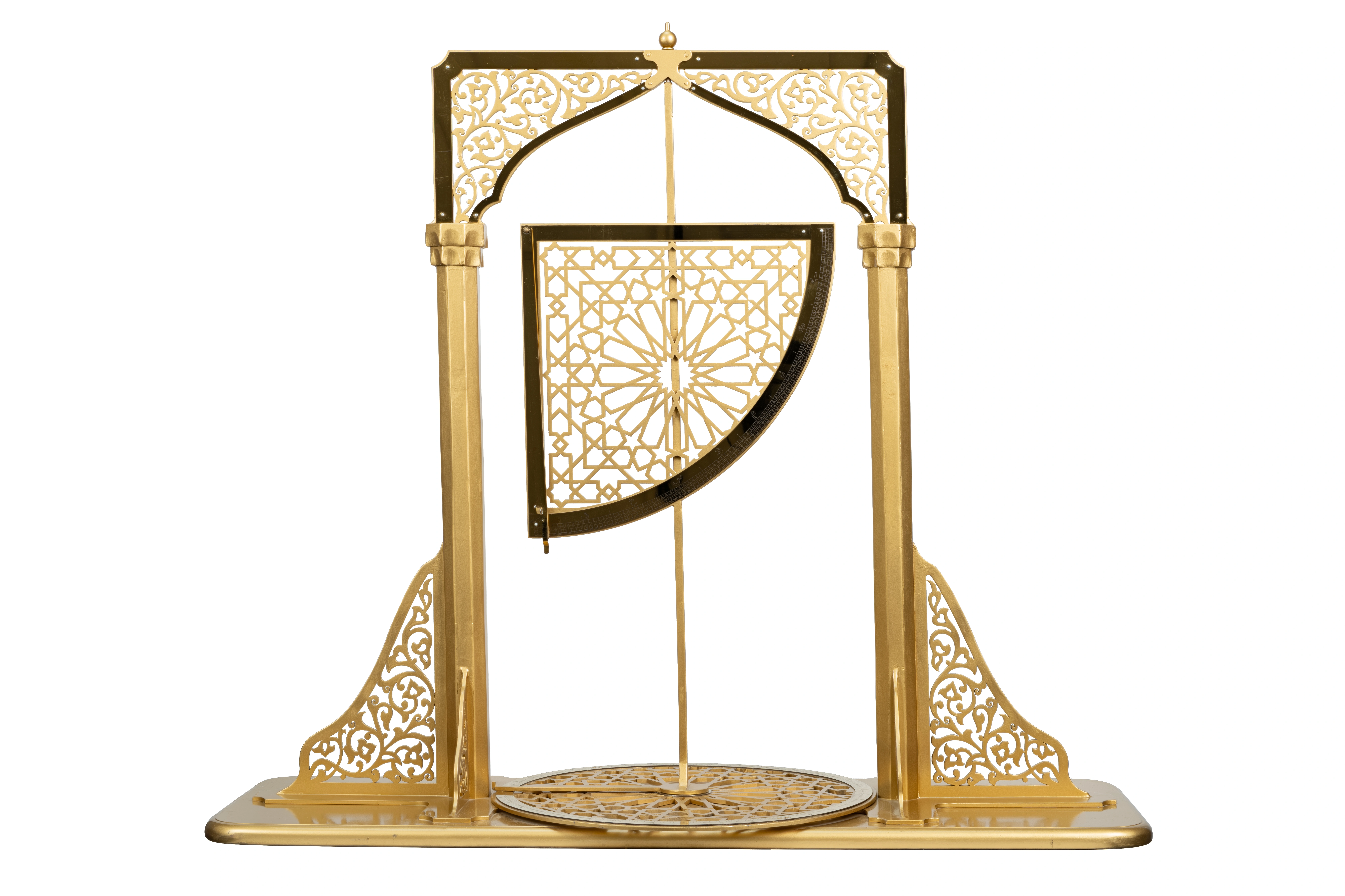
Sine Quadrant
15th century CE. Central Asia. 77.7 × 86 сm. Replica
Description
This large brass sine quadrant from the fifteenth century belongs to the most sophisticated computational instruments of Islamic science. Its impressive scale immediately indicates its function: such devices were intended not for travel, but for observatories, madrasas, and scientific workshops where highly accurate astronomical calculations were required.
Unlike the astrolabe, which served as a model of the celestial sphere, the sine quadrant functioned primarily as a mathematical instrument. Using graduated scales, a plumb line, and a trigonometric grid, scholars determined the altitude of the Sun, calculated prayer times, established the direction of the Qibla, and computed celestial coordinates. For astronomers of the Timurid period, such instruments formed part of everyday scientific practice.
The artistic design of the object is equally significant. Its geometric ornament recalls the architectural decoration of fifteenth-century Samarkand madrasas. In the intellectual culture of the Islamic East, mathematics, architecture, and astronomy were understood as interconnected disciplines grounded in the concept of cosmic harmony and order.
The precision of such instruments depended directly on their scale: the larger the instrument, the more detailed and accurate its divisions could be engraved. For this reason, large quadrants were especially valued in the scientific centres of Central Asia, where one of the leading astronomical traditions of the Islamic world developed during the age of Mirzo Ulugh Beg