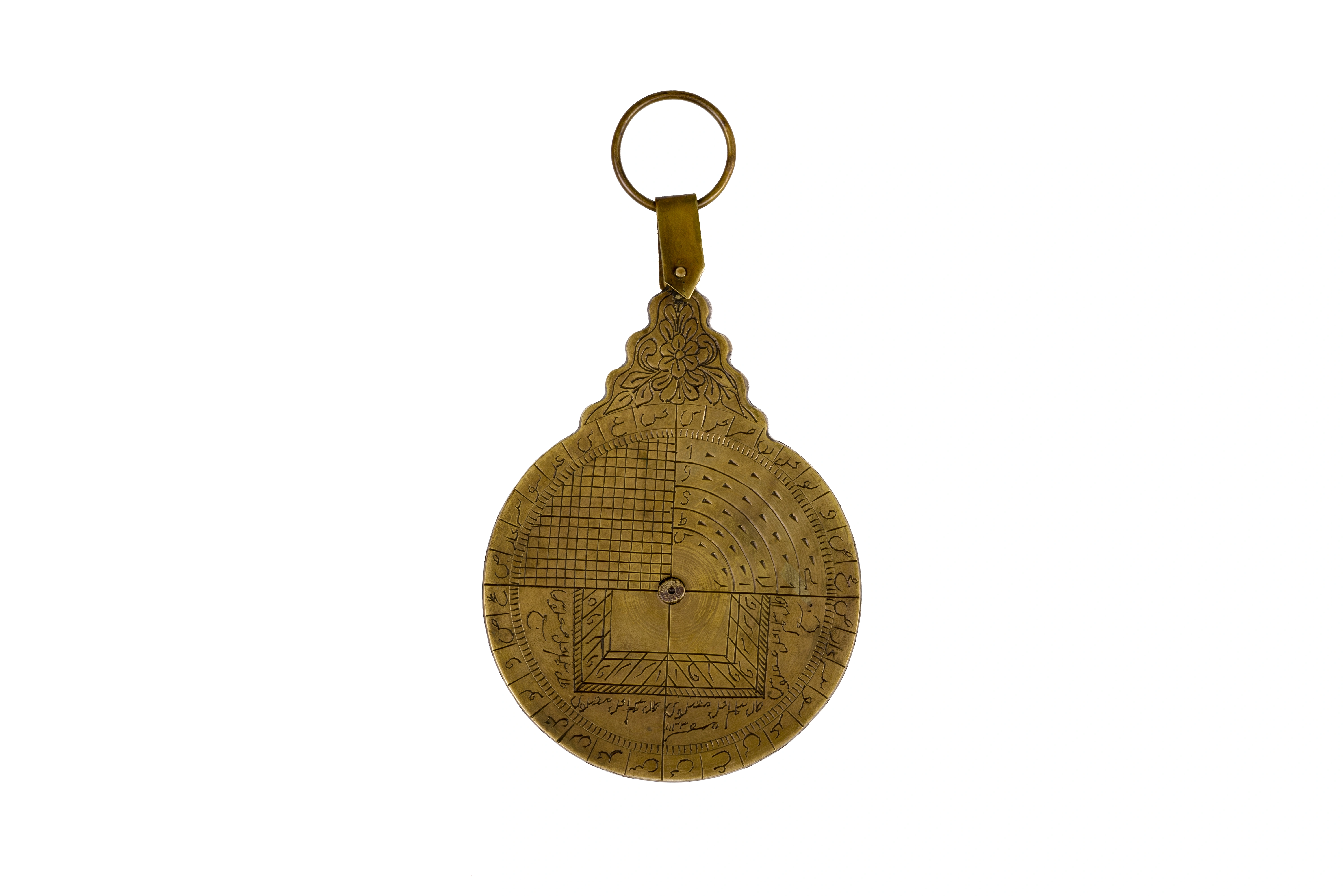
Astrolabe
1023 AH / 1611 СЕ. Samarkand. Brass. 17 × 9.7 cm. Gift from “ART VERNISSAGE” Auction House
Description
Before you is a Samarkand astrolabe dated 1611, created nearly a century and a half after the age of Mirzo Ulugh Beg. This compact instrument demonstrates how the scientific traditions of Central Asia continued long after the Timurid Empire had declined.
The astrolabe functioned as a universal scientific device. It could be used to determine time, calculate the positions of stars, find the direction of Mecca, and solve complex mathematical problems. In many ways, it was the analog “computer” of the seventeenth century.
Particularly important are the interchangeable plates, or tympans, displayed beside the main body. Each plate was designed for a specific geographic latitude. This allowed the owner to use the instrument in different cities across the Islamic world, from Samarkand to Mecca.
Notice the openwork rete. Its elegant shapes are both decorative ornament and a precise map of the heavens. In Islamic civilization, science and art were deeply interconnected: mathematical precision coexisted with refined calligraphy and vegetal ornament.
Despite its relatively small size, this astrolabe remains a remarkable testament to the sophistication of the Samarkand scientific tradition and its influence far beyond Central Asia.