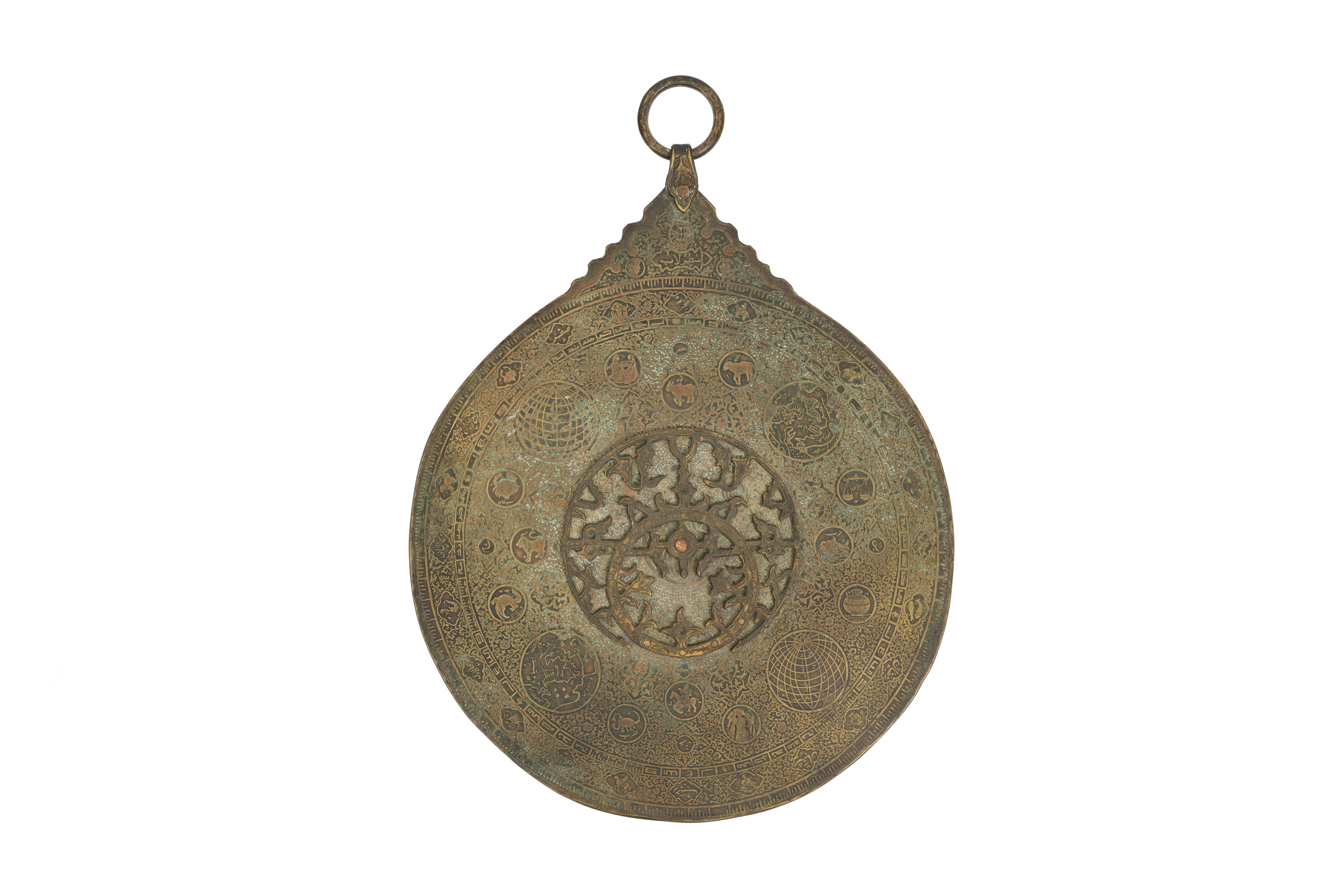
Astrolabe
15th century CE. Samarkand. 47.7 × 34.7 cm. WOSCU collection
Description
This object translates the sky into a mechanical system. By rotating its openwork grid, the positions of stars, the altitude of the Sun, and the horizon can be aligned within a single computational framework.
It is an astrolabe — a universal instrument of medieval astronomy. Its design is based on the projection of the celestial sphere onto a plane: a rotating rete, often called the “spider,” operates over graduated scales and interchangeable plates calibrated for different latitudes.
With a diameter approaching half a meter, this example is significantly larger than typical portable astrolabes. The increased scale allows for finer graduations and, consequently, greater precision. Instruments of this size were likely used in educational or scholarly environments, such as madrasas or observatory contexts.
The engraved surface reveals concentric zones: an outer ring with degree markings, inner fields with astronomical and calendrical grids, and symbols of the zodiac interspersed among stellar indicators. The central pivot organizes the entire rotational system.
Astrolabes were used to determine time from celestial altitudes, calculate the direction of Mecca, and teach the structure of the heavens. They functioned both as computational tools and as conceptual models of the cosmos.
Fifteenth-century Samarkand, associated with the scientific milieu of Ulugh Beg, was a major center for the development of precise astronomical instruments. However, a direct attribution of this object to the observatory would require additional evidence; it reflects a broader regional tradition.
This instrument embodies a critical phase in the history of science, where observation, geometry, and craftsmanship converge into a unified system of knowledge.