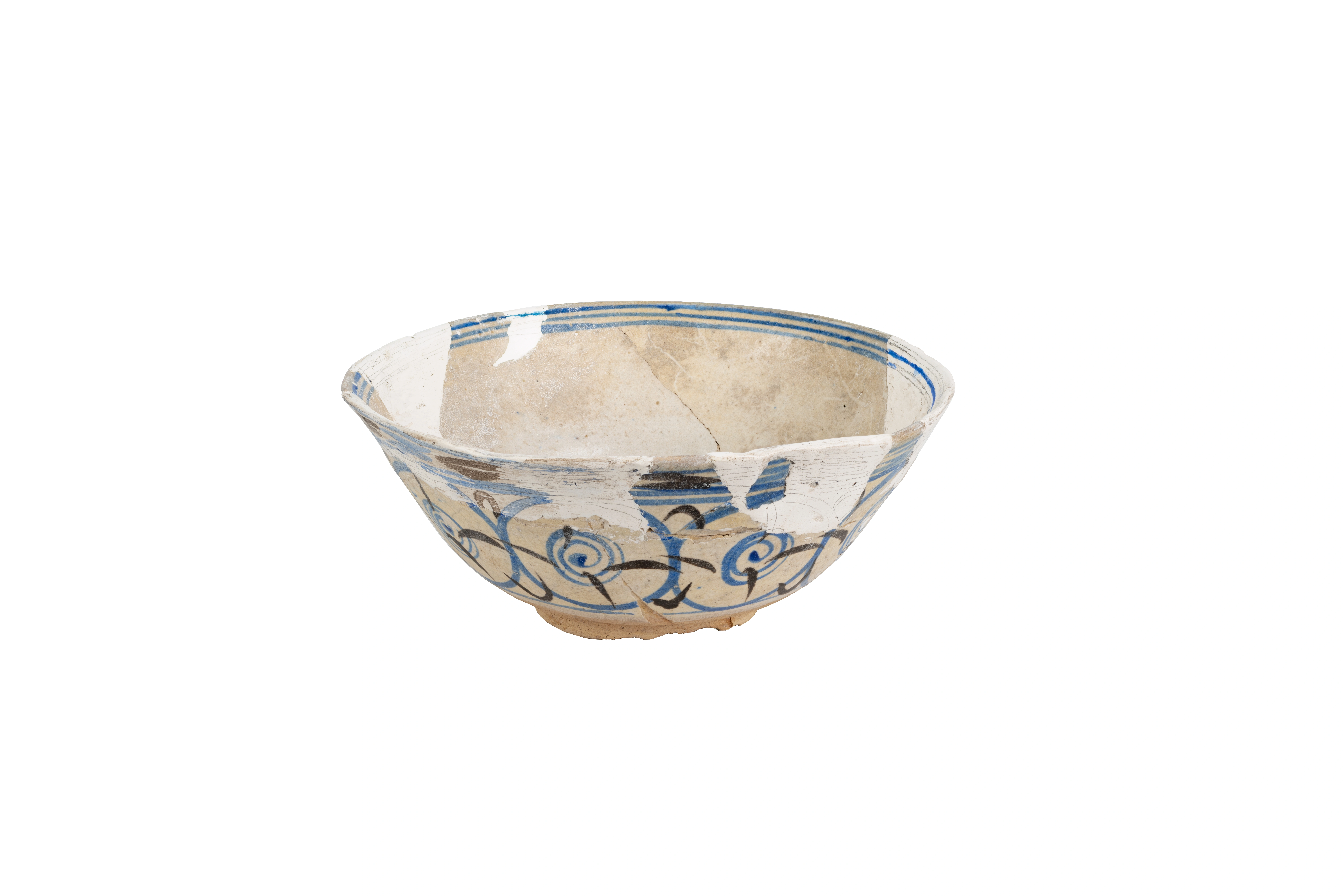
Bowl
16th century CE. Tashkent. Ceramic; engobe, decorated with cobalt pattern. 9 × 21.5 cm. WOSCU collection
Description
Sometimes the history of art survives not in palaces or manuscripts, but in everyday objects. This sixteenth-century bowl from Tashkent was created during a period when the cities of Central Asia were once again becoming major centers of craftsmanship, trade, and urban culture.
Its surface is coated with white engobe, a thin layer of liquid clay onto which the artisan painted cobalt decoration. After firing, the vessel was covered with a transparent glaze that gave the ornament its distinctive luminous sheen. This technique enabled local potters to imitate the appearance of Chinese porcelain, which was highly prized throughout the Islamic world.
The exterior decoration is especially expressive: blue spirals and flowing lines create a continuous rhythm suggestive of water currents or growing vegetation. In Islamic ornament, such motifs were often associated with infinity, vitality, and cosmic harmony.
At the center of the bowl appears a restrained vegetal motif. Compositions of this kind were carefully designed so that the viewer’s gaze gradually moved inward during use of the vessel.
Visible cracks and restoration traces reveal that the object survived only in fragmentary condition. Yet archaeological ceramics like this are invaluable evidence of how artistic ideas circulated along the Silk Roads — from China and Iran to Tashkent and Samarkand.
This bowl demonstrates that even utilitarian objects in the sixteenth century could serve as carriers of aesthetic meaning, technical knowledge, and cultural memory.