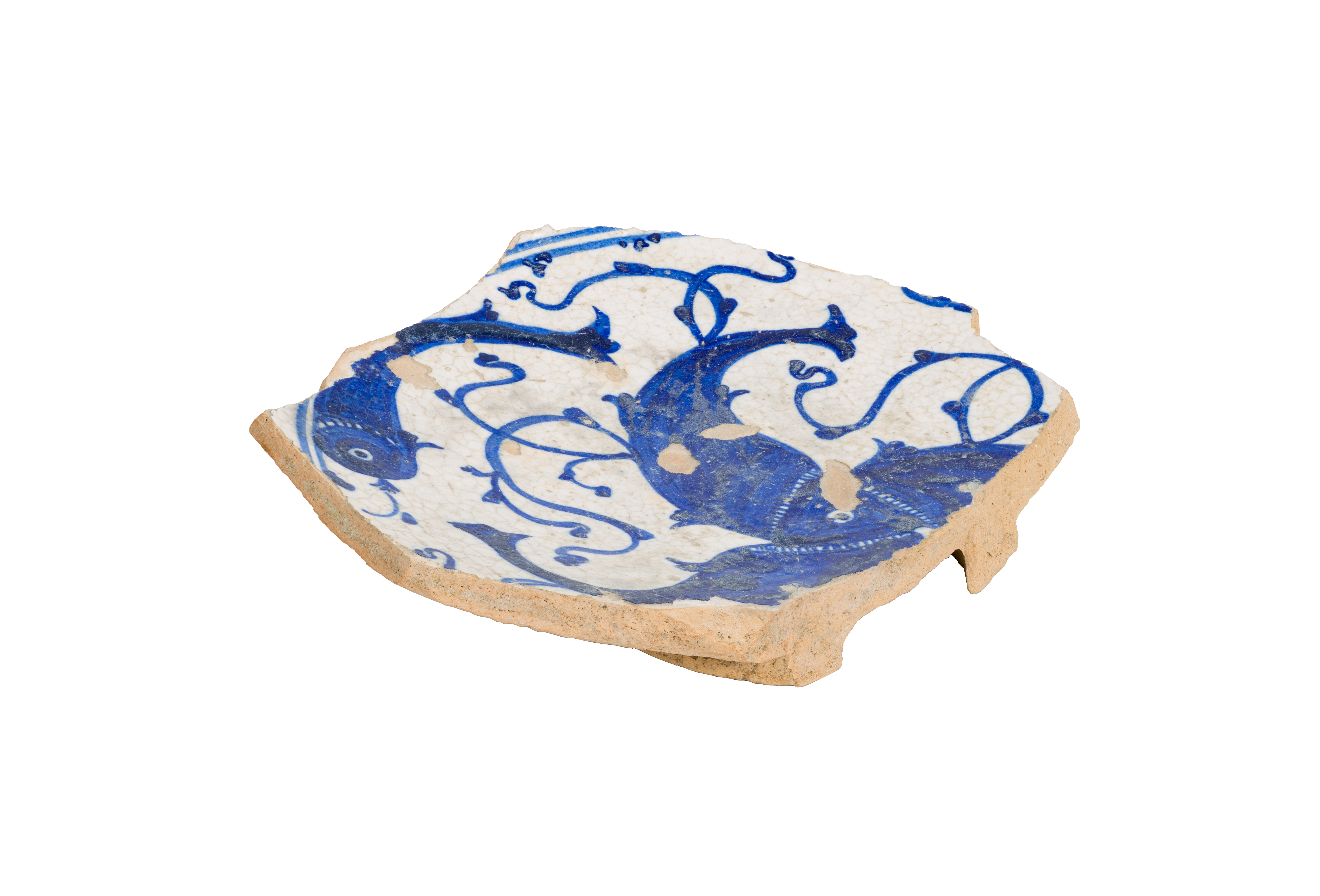
Dish (fragment)
16th century. Tashkent. Ceramic; engobe, glaze. 4.8 × 20.5 cm
Audio guide
Audio available in: UZ
Description
Even as a fragment, this dish reveals how the artistic language of Central Asia developed through interaction with global traditions.
The object represents part of a ceramic vessel produced in Tashkent in the sixteenth century—a period marked by intense cultural exchange along the Silk Road. Local artisans closely observed external influences and adapted them within their own craft practices.
The combination of a white ground with a deep blue design reflects the impact of Chinese Ming porcelain. Lacking access to true porcelain technology, craftsmen employed an alternative method: they covered the surface with a light engobe, painted the design with cobalt pigment, and sealed it with a transparent glaze. This technique achieved a comparable visual effect.
A stylized fish motif is clearly visible within the flowing ornament. In the artistic vocabulary of Central Asia, such imagery could be associated with water, life, and abundance—concepts of particular importance in an oasis-based environment.
The representation is not naturalistic. Instead, it follows decorative principles: forms are simplified, lines are rhythmic, and the composition emphasizes movement. In this way, the figurative motif becomes integrated into the broader ornamental system of Islamic art.
Tashkent in the sixteenth century was a significant center of craftsmanship. Its ceramics are distinguished by expressive brushwork and dynamic composition, qualities evident in the energetic curves and vitality of this fragment.
Thus, this object reflects not only a production technique, but also a broader cultural process—the synthesis of traditions that shaped the artistic identity of Islamic Central Asia.