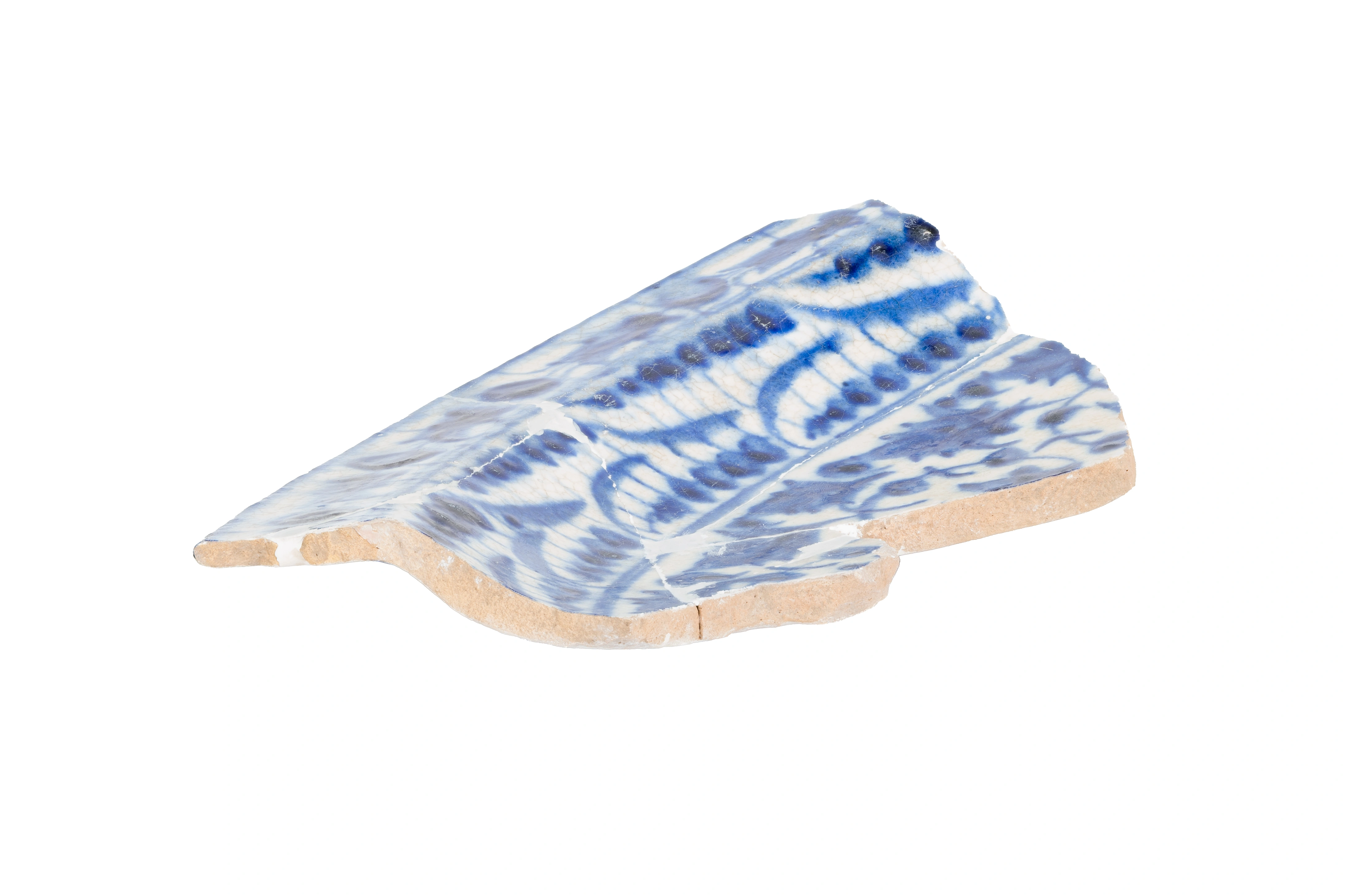
Plate (fragment)
15th century. Tashkent. Ceramic; colorless glaze. 3 × 22.5 cm
Audio guide
Audio available in: UZ
Description
This fragment of a fifteenth-century ceramic plate from Tashkent illustrates the artistic and technological developments of Timurid Central Asia. Even in its incomplete state, it provides valuable evidence of the aesthetic preferences and technical skills of local ceramic workshops.
The decoration was executed in cobalt pigment beneath a transparent glaze, a technique widely used in Islamic ceramics of the late medieval period. The combination of a white ground with blue ornament was highly prized along the Silk Road and inspired regional adaptations.
The surviving decoration shows a combination of vegetal motifs and rhythmic border patterns. The careful structure of the design reflects the geometric principles typical of Islamic ornament, where visual order and repetition conveyed broader concepts of harmony.
Technically, the use of a white engobe allowed potters to imitate the appearance of porcelain, while the transparent glaze protected the painted decoration and enhanced its visual clarity.
Fragments such as this illustrate the participation of fifteenth-century Tashkent in the wider artistic exchanges that connected Central Asia with the broader Eurasian world.