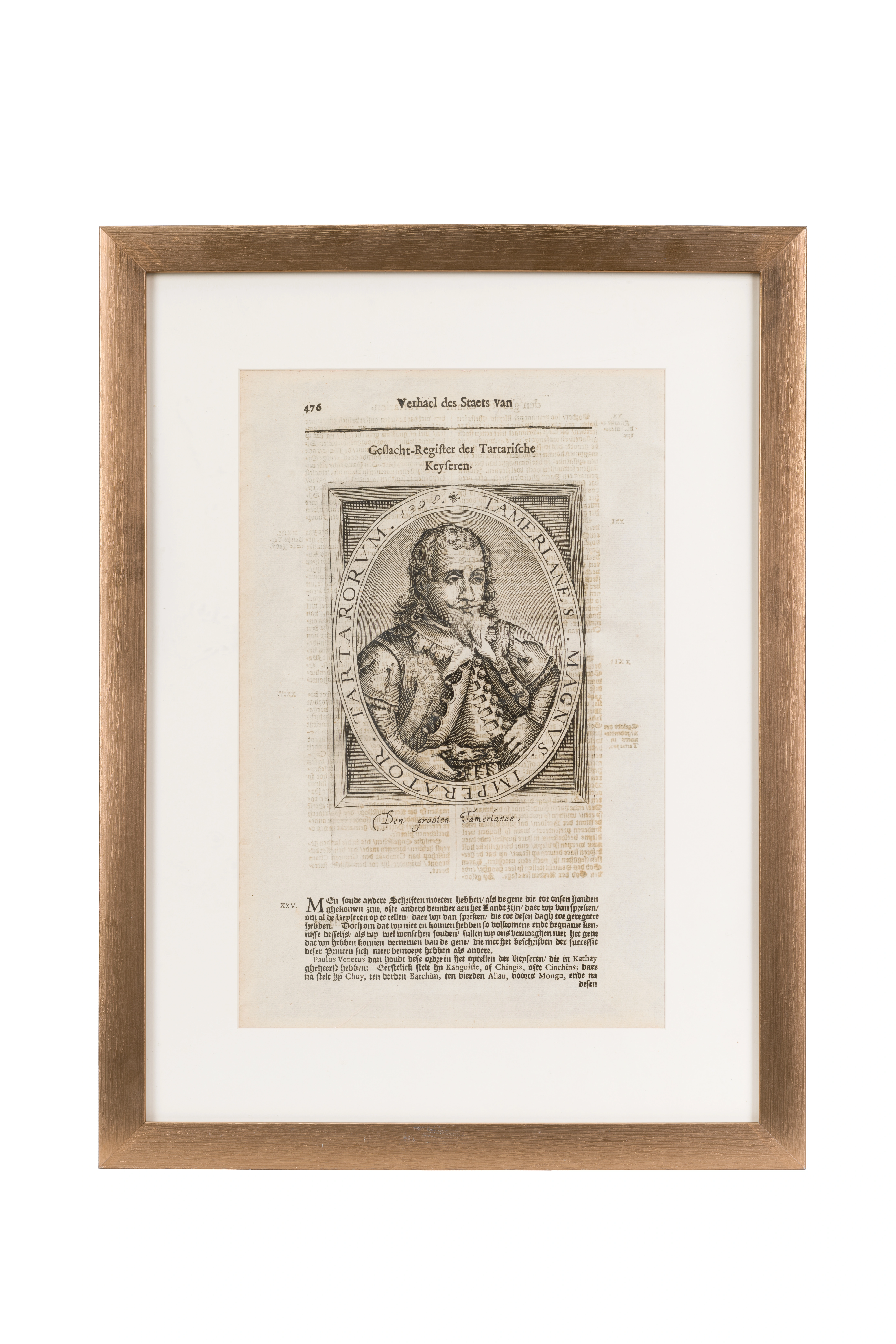
Amir Timur through the Eyes of Europeans
From the “States, kingdoms and principalities all over the world”. 1584 CE. Denmark. Рaper; printed edition. 30 × 20.5 cm. WOSCU collection
Audio guide
Audio available in: RU
Description
This engraving represents another European interpretation of Amir Timur from the late sixteenth century. It demonstrates how rapidly the image of the Central Asian ruler spread throughout the intellectual networks of Renaissance Europe.
If you look closely, you may notice similarities between this portrait and earlier French engravings. This is not accidental. In the sixteenth century, successful visual models were frequently copied and republished across Europe, creating standardized visual representations of historical figures.
The Latin inscription surrounding the portrait refers to Timur as the “Great Emperor of the Tartars.” European scholars applied familiar imperial terminology, even though Timur himself used the Islamic title of Amir.
The accompanying text is also significant. It discusses his genealogy and possible connections to the lineage of Genghis Khan. This reflects an attempt by European historians to interpret the legitimacy of Eastern rulers through dynastic concepts familiar to European political thought.
This engraving demonstrates that by the late sixteenth century, Samarkand and the Timurid state were already recognized in Europe as important components of global history.