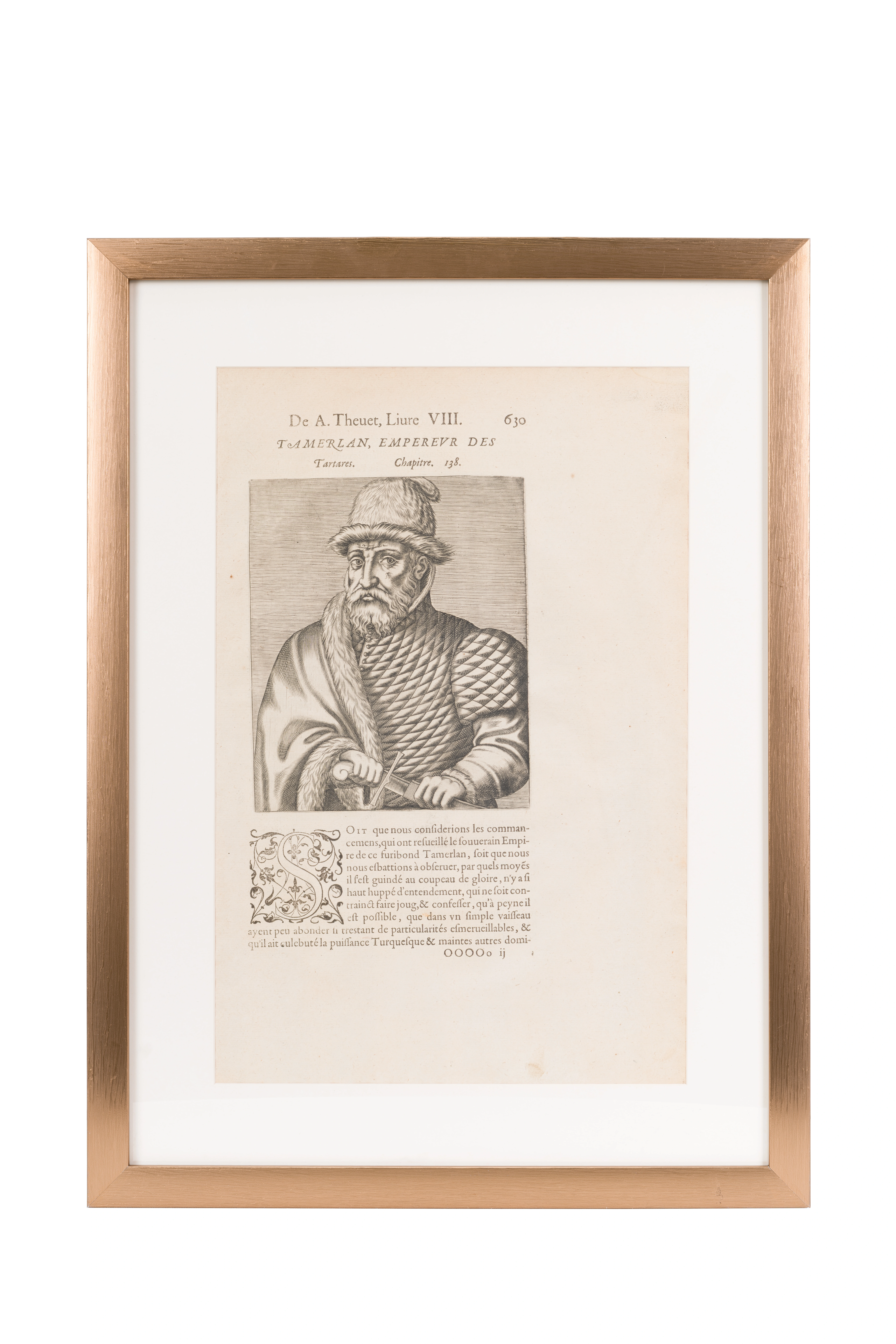
“Amir Timur through the Eyes of Europeans”. Gravure
1584 CE. Paris. Paper; printed edition. 38 × 25 cm. WOSCU collection
Audio guide
Audio available in: RU
Description
This engraving represents one of the earliest European portraits of Amir Timur, created in 1584 by the French cosmographer André Thevet for his publication dedicated to the lives of famous rulers.
It is important to note that the artist never saw Timur, who had died almost two centuries earlier. The image is therefore a scholarly reconstruction based on historical chronicles, travel accounts, and European interpretations of Islamic rulers.
Notice the visual details. Timur is depicted wearing a fur hat and heavy garments, with elements of armor visible beneath the fabric. This imagery was intended to emphasize his identity as a powerful ruler of the northern Islamic world and the founder of a vast empire.
His hand resting on the hilt of the sword is symbolic gesture. In both European and Islamic visual traditions, this gesture signified authority, military leadership, and legitimate sovereignty.
The accompanying text is equally revealing. Timur is described as the Emperor of the Tartars, one of the highest titles a European author could attribute to an Eastern ruler. This reflects a growing recognition of Central Asia as a region of sophisticated political power.
For more than two centuries, this engraving influenced how Timur was visually represented in European historical literature.