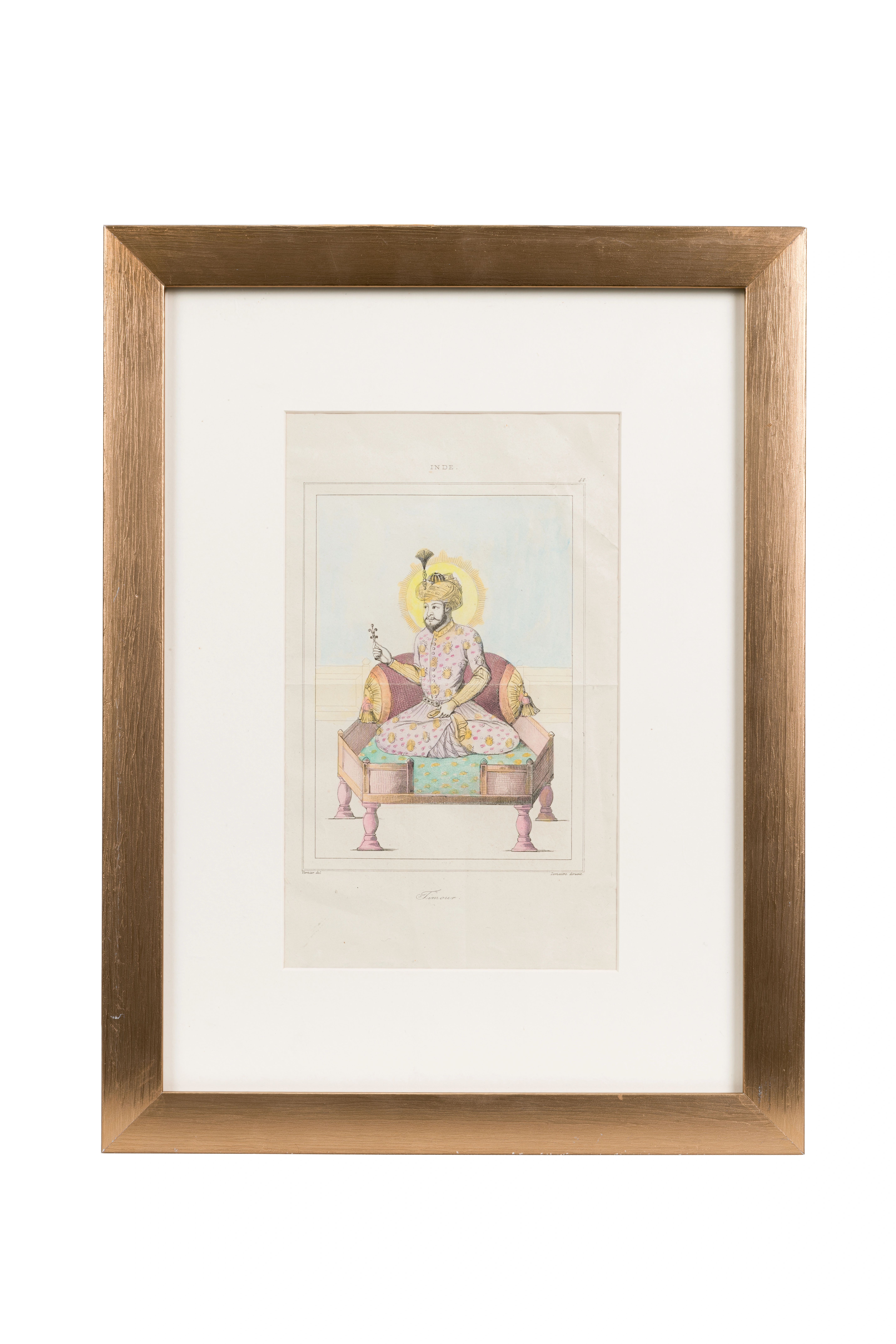
“Amir Timur on the Golden Throne”. Gravure
Early 18 century CE. India. Paper; tempera. 19.2 × 10.4 cm
Audio guide
Audio available in: RU
Description
This engraved portrait of Amir Timur was created in early 18th-century India, at a time when the rulers of the Baburid Empire actively promoted the image of their celebrated ancestor.
Although Timur lived in the 14th and 15th centuries, his image remained a powerful political symbol within the empire. Portraits like this emphasized the dynasty’s genealogical connection to Timur and reinforced the legitimacy of imperial authority.
The ruler is shown seated ceremonially on an ornate throne. The golden halo surrounding his head symbolizes the sacred nature of kingship, a motif rooted in Persian and Indian artistic traditions. In his hand, he holds an emblem of sovereignty associated with the title Sahibqiran, referring to a ruler believed to be destined for greatness according to the alignment of the stars.
The technique is also significant. This is a hand-colored engraving, a common artistic practice in 18th-century India. Such works were often created either as illustrations for historical manuscripts or as independent courtly artworks.
This portrait shows how Timur’s image continued to shape ideas of rulership and political legitimacy in the Islamic world long after his lifetime.