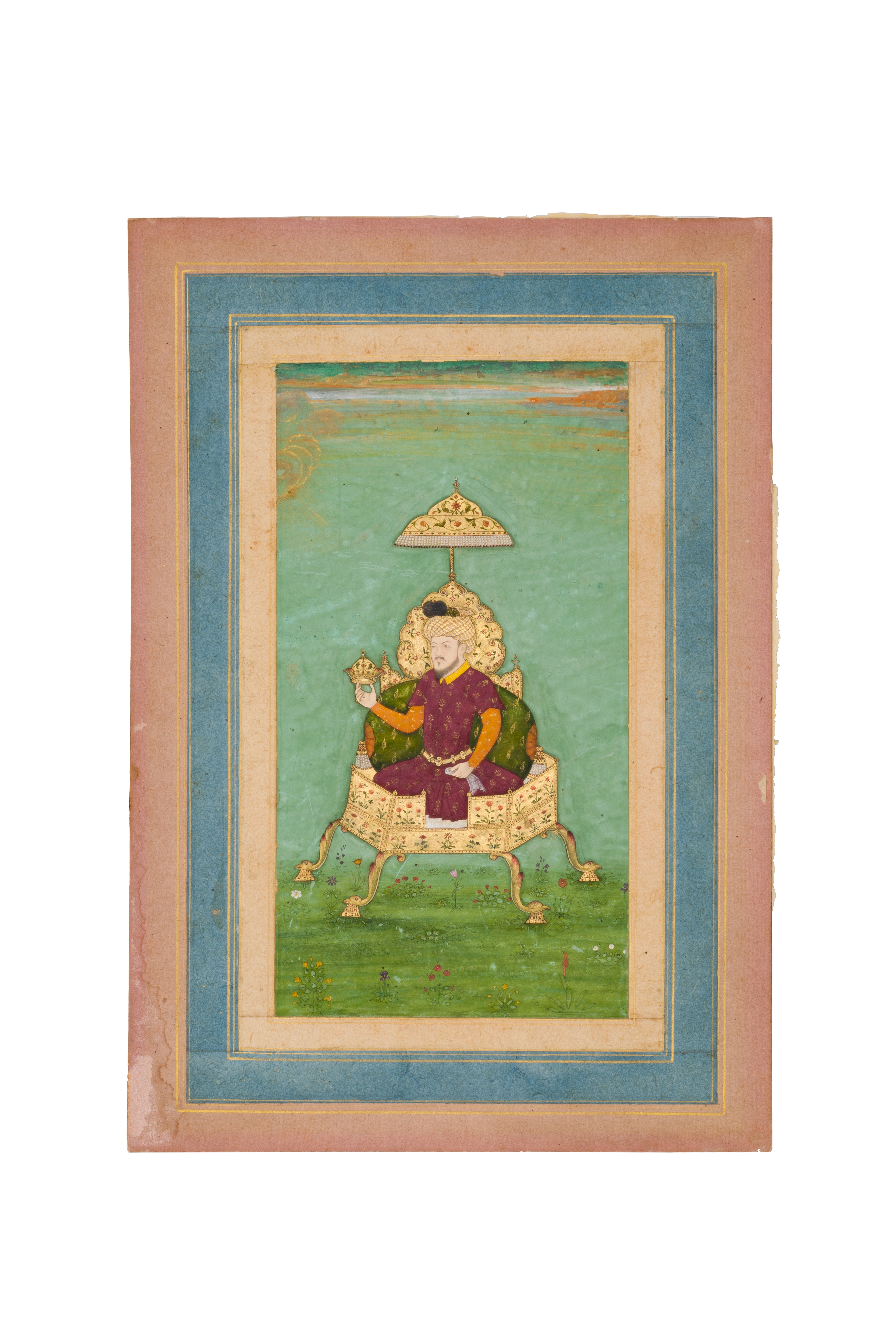
“Amir Timur on the Golden Throne”. Miniature
Early 18 century CE. India. Paper mounted on fabric; tempera. 22.5 × 13.3 cmFrame: 57.2 × 44.5 cm
Audio guide
Audio available in: RU
Description
This miniature was created in early 18th-century India and belongs to the artistic tradition of the Baburid Empire.
Although it was produced nearly three centuries after the death of Amir Timur, it reflects important political and cultural ideas of that later period.
The rulers of the empire regarded themselves as direct descendants of Timur through the dynasty’s founder, Babur. Portraits like this served as visual statements of dynastic legitimacy and imperial continuity.
Timur is shown seated ceremonially on an ornate golden throne. Above him is a ceremonial parasol, known as a chatri—a traditional Indian symbol of sovereignty and divine protection. In his hand, he holds a crown, referring to his title Sahibqiran, a ruler believed to be favored by the alignment of the stars.
The miniature combines elements of the Persian and Indian artistic traditions. This fusion can be seen in the delicate rendering of textiles, jewelry, and the richly decorated throne, as well as in the stylized landscape in the background.
This image shows how the memory of Timur remained a powerful political symbol in the Islamic world long after his lifetime.