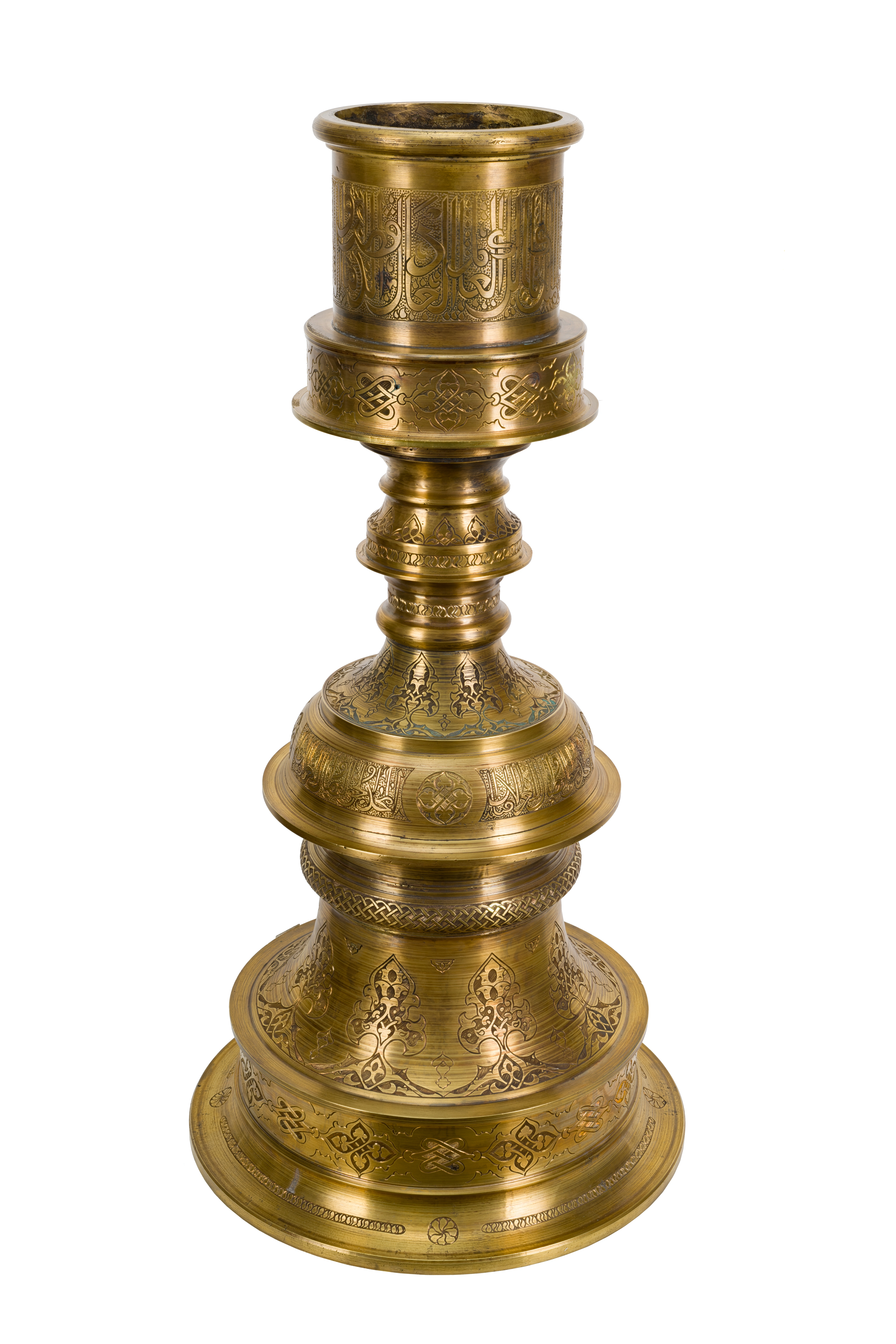
Candlestick for the Mausoleum of Khoja Ahmad Yassavi
15 century. Central Asia. Bronze. 83.5 × 42 cm. Replica
Audio guide
Audio available in: RU
Description
This monumental 15th-century candlestick was created for the mausoleum of Khoja Ahmad Yasawi, one of the most important spiritual centers in Central Asia.
Although the object displayed here is a replica, it accurately reproduces the original commissioned during the reign of Amir Timur. It formed part of a carefully designed ensemble intended for the sacred architectural space in Turkestan.
The candlestick served not only a practical function. In Islamic, and especially Sufi tradition, light symbolizes “nur” – the divine radiance of knowledge and truth. The flame was therefore understood as a metaphor for the spiritual presence of the saint.
Its surface is richly decorated with a combination of epigraphy and ornament. Raised calligraphic inscriptions include religious formulas and blessings, seamlessly integrated into vegetal “islime” motifs and geometric interlace patterns.
The form of the object is strictly hierarchical. A wide base transitions into a narrowing shaft and culminates in a cylindrical upper section. This vertical composition emphasizes stability, elevation, and an upward orientation toward light.
Technically, such objects were produced using the lost-wax casting method, followed by detailed engraving. This allowed artisans to achieve a high level of precision and ornamental depth.
The scale of the piece is also significant. Standing over 80 centimeters tall, it was intended for large architectural interiors and reflects the importance of the mausoleum as a major pilgrimage site.
This candlestick embodies a key feature of the Timurid era – the integration of political authority with spiritual legitimacy, where artistic form became a carrier of religious meaning.