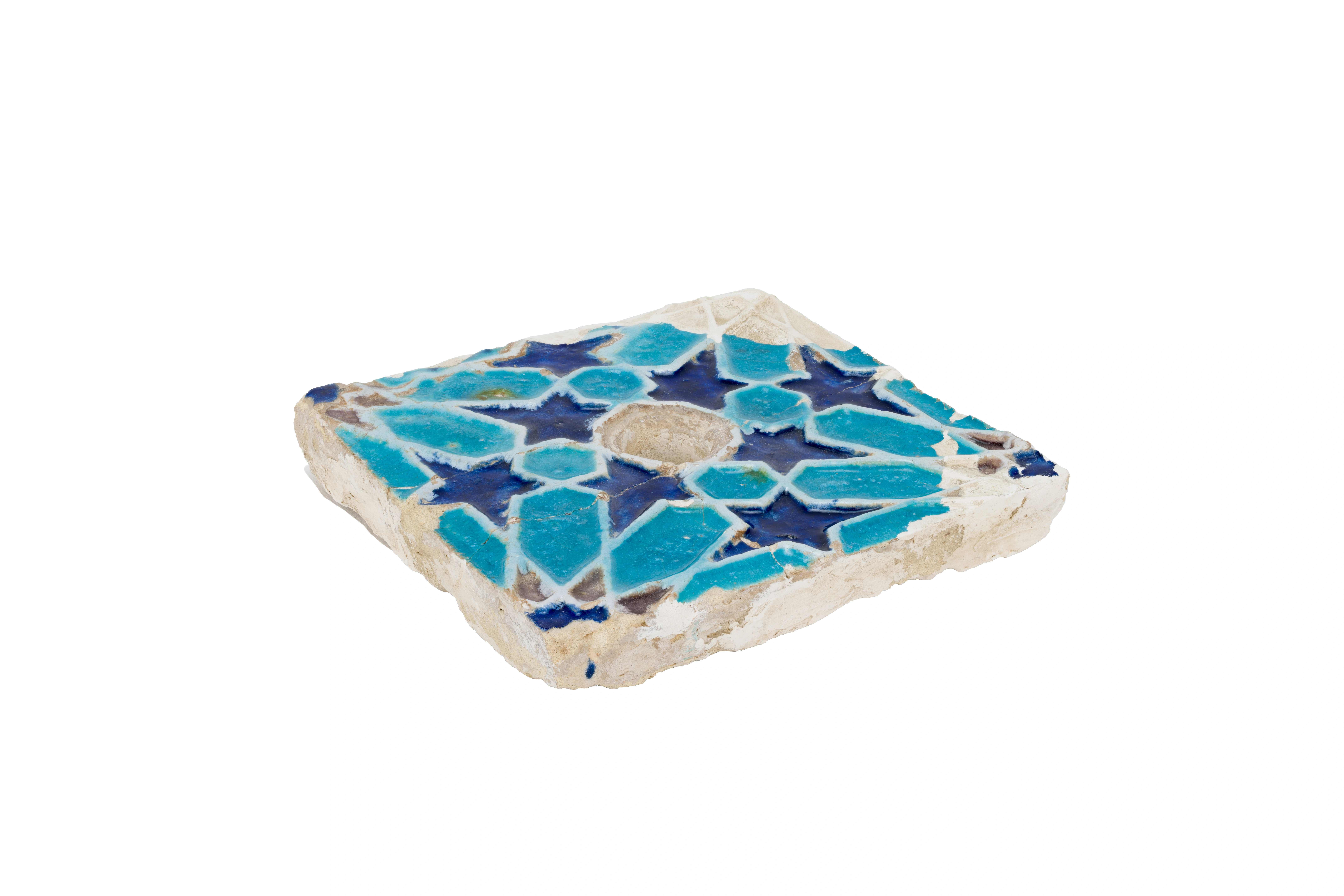
Architectural Tile
14th century. Samarkand. Ceramic. 20.5 × 19.8 cm
Audio guide
Audio available in: UZ
Description
This object is a ceramic tile from the 14th century, produced in Samarkand, one of the major artistic centers of the Timurid era.
Tiles of this type once decorated the architectural monuments of the city, including mosques, mausoleums, and madrasas. Arranged together, they created intricate geometric compositions that transformed architectural surfaces into patterns of color and light.
The decoration on this tile represents a classic example of girih ornament. The word “girih” in Persian means “knot.” It refers to a complex geometric network based on the combination of polygons. Craftsmen constructed such patterns according to strict mathematical principles, creating compositions that appear to extend infinitely.
At the center of the design is an eight-pointed star, a common motif in Islamic architecture symbolizing harmony and cosmic order.
The palette of deep blue and turquoise is characteristic of Samarkand’s architectural ceramics. These colors symbolized the sky and water and gave buildings a luminous appearance.
In Islamic architectural decoration, geometric patterns like this replaced figurative imagery. Their endless repetition invited contemplation of the infinite nature of the universe and the divine order underlying it.