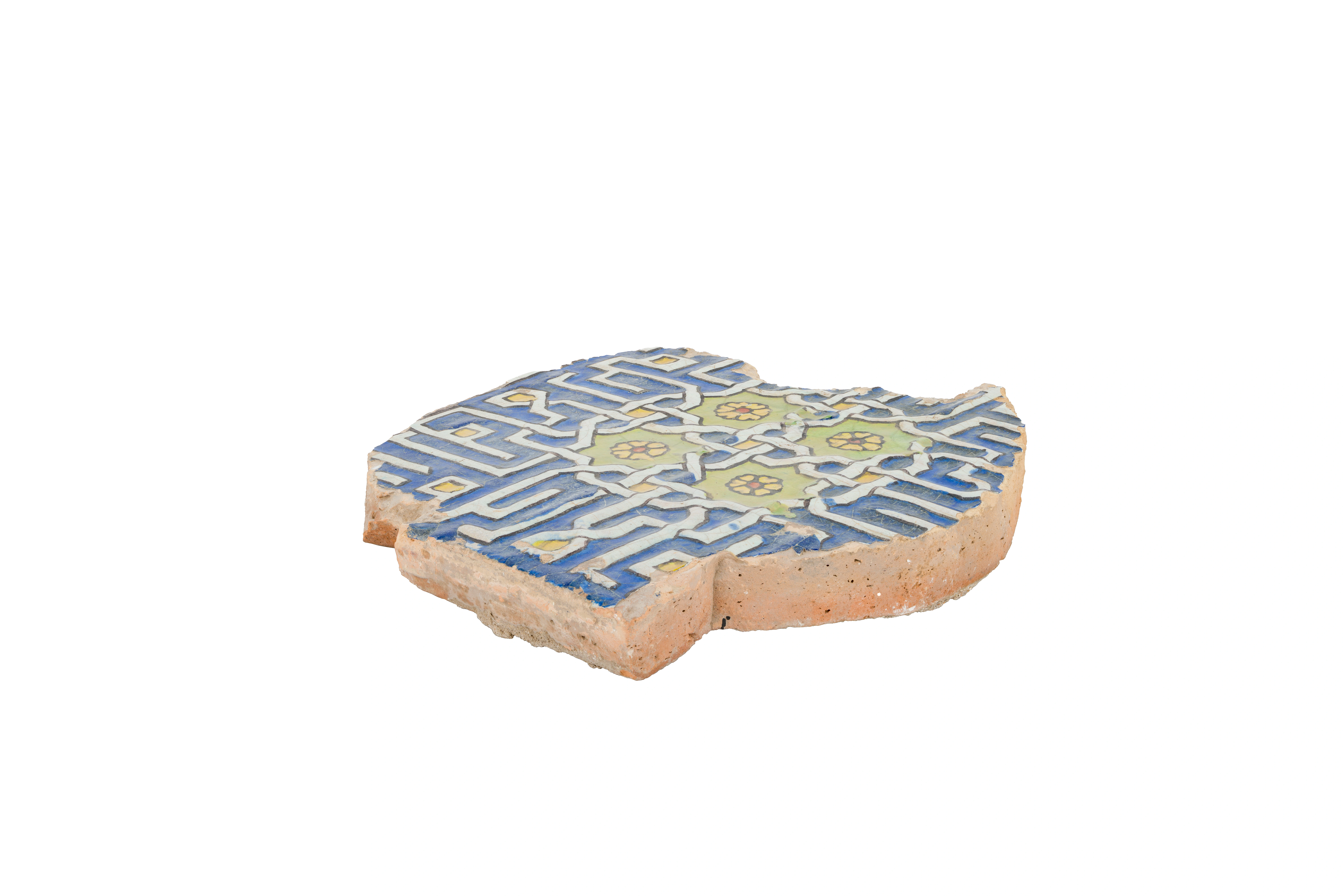
Architectural Tile Fragment
14th century. Samarkand. Ceramic.
Audio guide
Audio available in: UZ
Description
This object is a fragment of a ceramic tile from 14th-century Samarkand, a period when the city was transforming into the capital of Amir Timur’s vast empire.
Tiles like this decorated the façades of mosques, mausoleums, and madrasas. Together they formed intricate decorative compositions that covered architectural surfaces with geometric patterns.
The ornament on this tile is based on the girih principle, a geometric design fundamental to Islamic art. The word “girih,” meaning “knot” in Persian, refers to complex networks of interlacing lines constructed through precise mathematical geometry. Such patterns can theoretically extend infinitely, symbolizing the harmony and eternity of the universe.
At the center of the composition appears an eight-pointed star, one of the most common motifs in the architecture of Samarkand. White lines form the structural framework of the design, while blue and yellow elements fill the spaces between them, creating the illusion of interwoven ribbons.
The deep cobalt blue color symbolized the heavens and spiritual elevation, while the golden-yellow rosettes resemble stylized lotus flowers—a motif introduced to Central Asia through cultural exchange along the Silk Road.
Tiles like this once decorated the great monuments of Samarkand, including the Shah-i Zinda complex, the Bibi-Khanum Mosque, and the Gur-e Amir mausoleum.