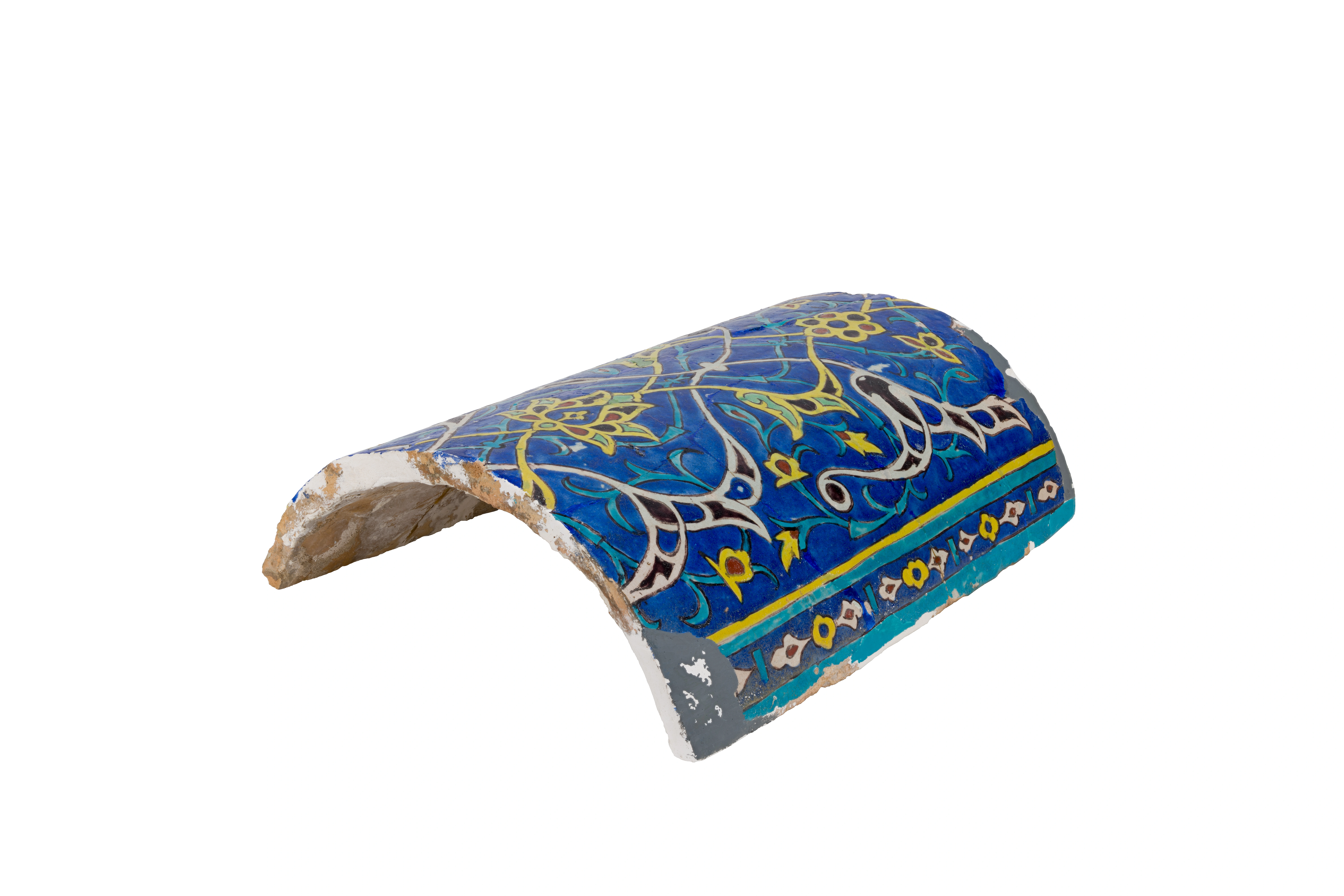
Architectural Tile Fragment
15th century. Samarkand. Ceramic. 44.8 × 33.5 cm
Audio guide
Audio available in: UZ
Description
This object is a fragment of architectural decoration from 15th-century Samarkand, representing the ceramic art of the Timurid period.
Tiles like this once decorated the façades of madrasas, mausoleums, and palaces, transforming entire architectural surfaces into elaborate ornamental compositions. During this period, Samarkand was one of the most important artistic centers of the Islamic world.
The fragment was produced using the cuerda seca technique, meaning “dry cord.” Unlike mosaic decoration, where each color is formed from a separate piece of tile, here multiple colors were applied to a single surface. To prevent the glazes from mixing during firing, artisans traced the outlines of the design with a greasy mixture containing manganese. When fired, the organic medium burned away, leaving the characteristic dark outlines visible on the tile.
The ornament combines flowing arabesques with a stylized lotus flower. The lotus motif entered Central Asian art through cultural exchanges with China and became widely used during the Timurid period.
The vivid palette of cobalt blue, turquoise, and yellow would have created a radiant surface in sunlight. Such elements likely formed part of the decoration of a dome drum or a monumental portal of one of Samarkand’s grand buildings.