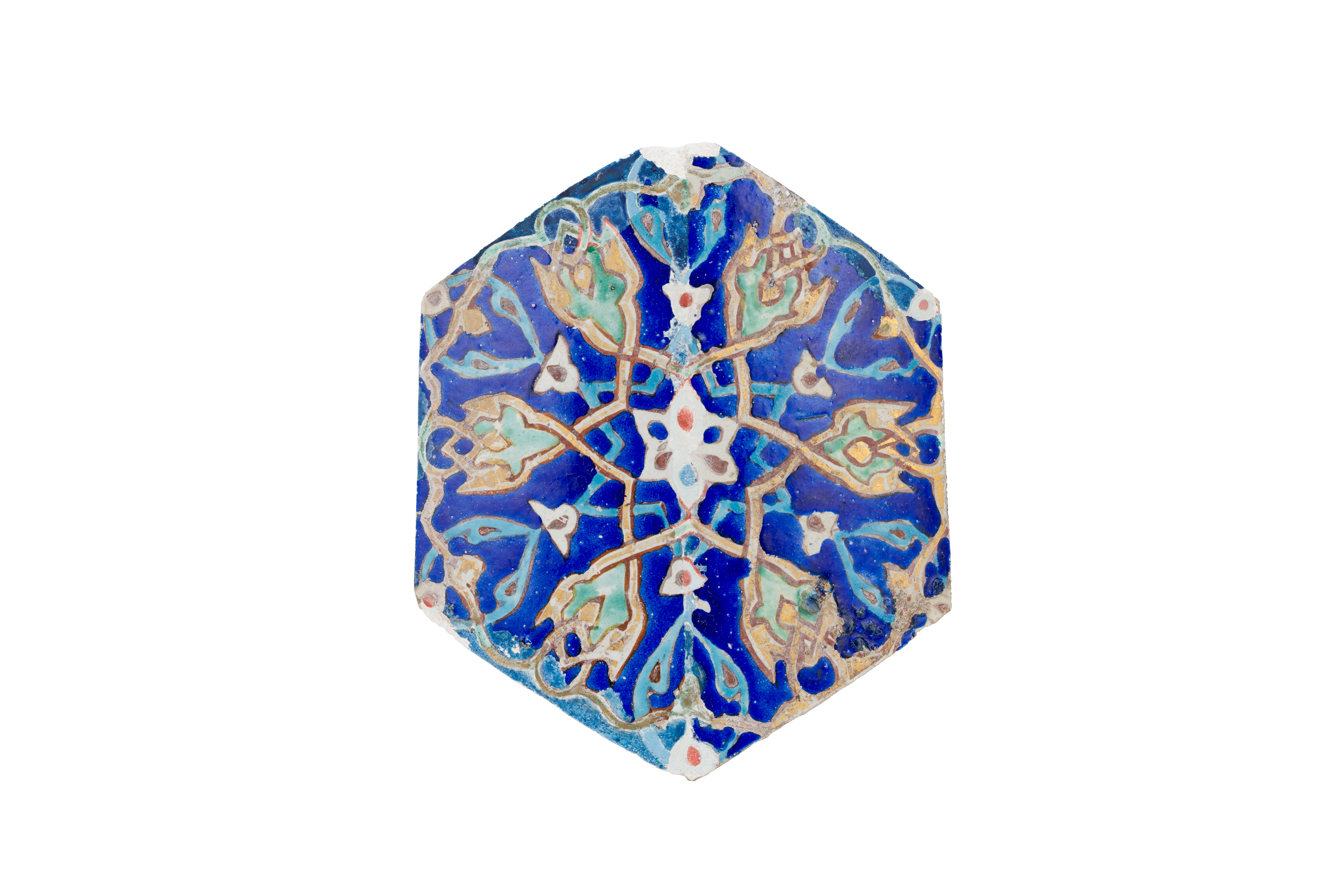
Architectural Tile Fragment
15th century. Mawarannahr. Ceramic. 30.5 cm
Audio guide
Audio available in: UZ
Description
This object is a fragment of a decorative tile from the 15th century, created in the region of Mawarannahr during the Timurid period.
The tile has a hexagonal shape. Tiles of this form were arranged together to create continuous decorative surfaces covering walls, portals, and domes of monumental buildings.
The piece was produced using the cuerda seca technique, meaning “dry cord.” Artisans applied a dark, greasy mixture containing manganese along the outlines of the design. These lines prevented differently colored glazes from mixing during firing, resulting in sharply defined patterns.
At the center of the composition is an eight-pointed star, a common motif in Islamic geometric design. From this central element extend symmetrical vegetal forms and arabesques that create a balanced ornamental structure.
Tiles like this once decorated the great monuments of Samarkand, where the combination of cobalt blue, turquoise, and green glazes created dazzling architectural surfaces under the bright Central Asian sun.