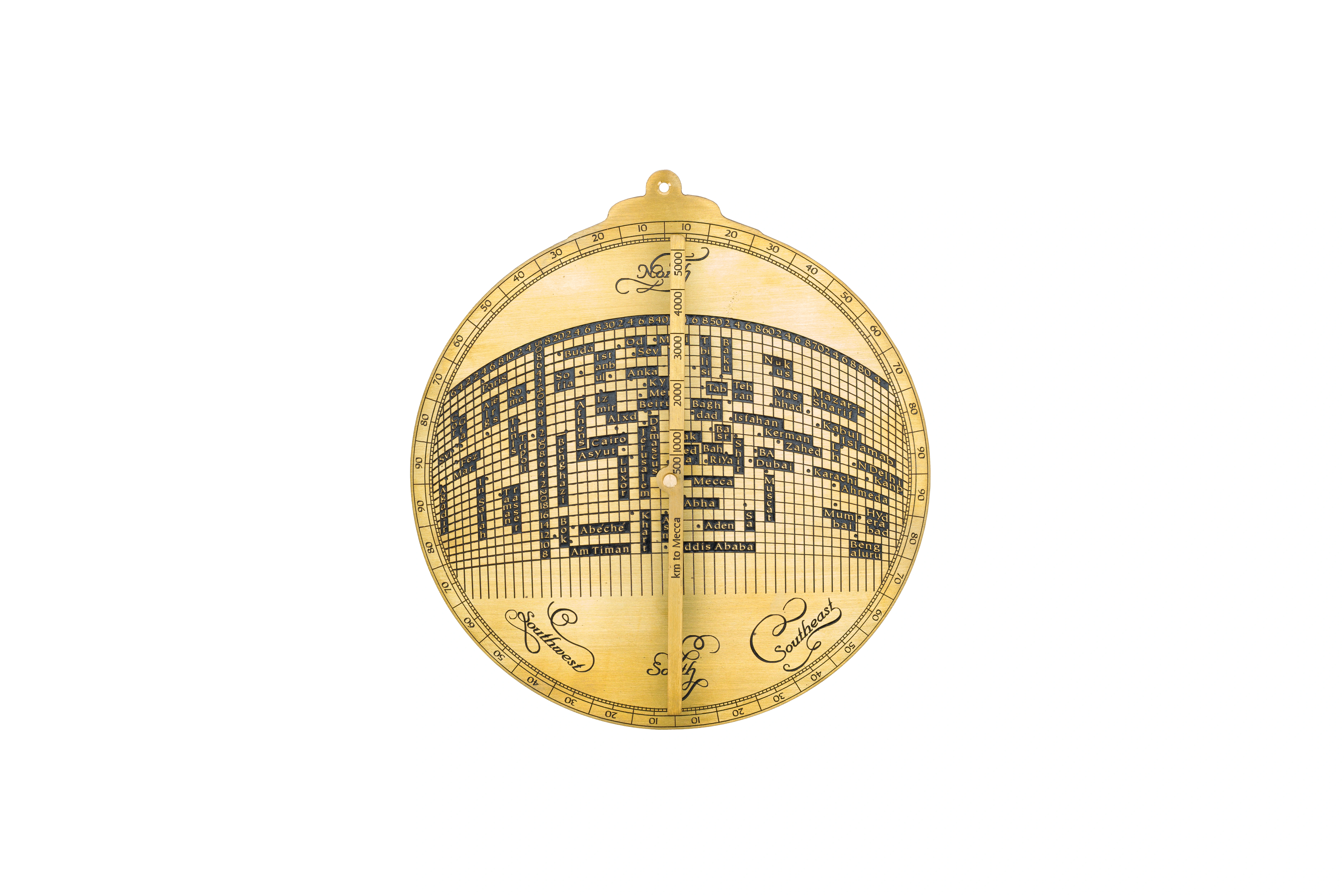
Qibla Compass
12th century CE. Central Asia. Diameter: 18 cm. Replica
Audio guide
Description
This object is a qibla compass–an instrument that brings together religious practice and the exact sciences. Its purpose is to determine the direction of Mecca, toward the Sacred Kaaba, a required orientation for Muslim prayer.
At its core is a magnetic compass indicating north. The qibla compass, however, adds a calculated scale that converts north into a precise azimuth toward Mecca, based on the user’s geographical location. In this way, devotion relies on applied knowledge of mathematics, geography, and astronomy.
Such instruments became widespread in Central Asia during the 12th century, used by scholars, travelers, caravan communities, and religious authorities. In the era known as the First Renaissance, the region was deeply connected to the scientific networks of the Islamic world, where determining directions and coordinates was a practical science.
Although this exhibit is a replica, it faithfully demonstrates the working principles of medieval originals. The qibla compass illustrates how scientific knowledge was embedded in everyday religious life–serving as a precise tool for prayer, travel, and orientation in the world.