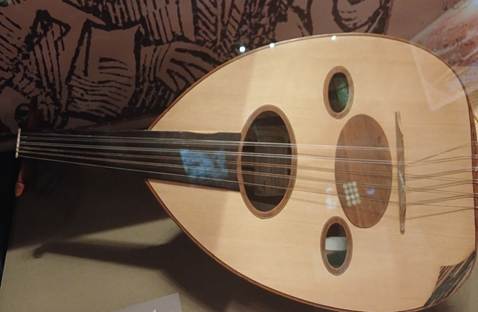
Oud - Musical Instrument
Central Asia. 78.6 × 34.5 × 25.5 cm. Replica
Audio guide
Audio available in: UZ
Description
This object is an oud, one of the principal string instruments of the classical musical tradition of the Islamic world. The exhibited piece is a reconstruction illustrating the form and structural features of the instrument as used in Central Asia.
The oud has a pear-shaped body, a short neck, and multiple sound holes on the soundboard. Unlike many European instruments, it has no frets, allowing the performance of microtonal intervals, which are fundamental to modal systems known as maqams.
The name “oud” derives from an Arabic term associated with wood, the primary material traditionally used in its construction. Through cultural transmission, the instrument became the prototype of the European lute and significantly influenced the development of string music in medieval Europe.
In the scientific culture of the Islamic world, music was considered a branch of mathematical knowledge. Scholars such as Al-Farabi analyzed intervals, tuning systems, and acoustic properties of instruments, including the oud, within numerical frameworks.
The instrument served not only for musical performance but also as a tool for theoretical exploration of sound, rhythm, and harmony. It was present in scholarly and poetic gatherings in cities such as Samarkand and Bukhara.
This exhibit highlights the connection between musical practice and scientific thought, demonstrating the contribution of Central Asia to the development of medieval music theory.