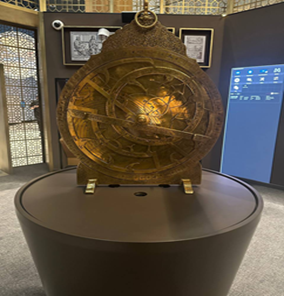
Astrolabe
12th century CE. Central Asia. Brass. Height: 74.6 cm
Audio guide
Description
This object is a 12th-century astrolabe, one of the most sophisticated astronomical instruments of medieval science. Made of brass, its large size suggests use in stationary observation rather than as a portable device.
An astrolabe is a flat model of the celestial sphere. The main plate contains a coordinate grid, over which a movable openwork plate represents the positions of prominent stars. By rotating this system, users could determine the altitude of celestial bodies, estimate time, and orient themselves using the sky.
The instrument was capable of solving a wide range of problems, including calculating sunrise and sunset times, determining geographical latitude, and finding the direction toward Mecca, known as the qibla.
In the scientific tradition of the Islamic world, the astrolabe was closely connected with advances in mathematics and astronomy. Scholars such as Al-Biruni refined its theoretical foundations and methods of use.
The large format of this instrument allowed for greater precision compared to smaller portable astrolabes. Its surface is engraved with fine scales, numerical divisions, and inscriptions necessary for practical calculations.
This exhibit reflects the high level of scientific development in 12th-century Central Asia, where astronomy served both practical and religious functions.