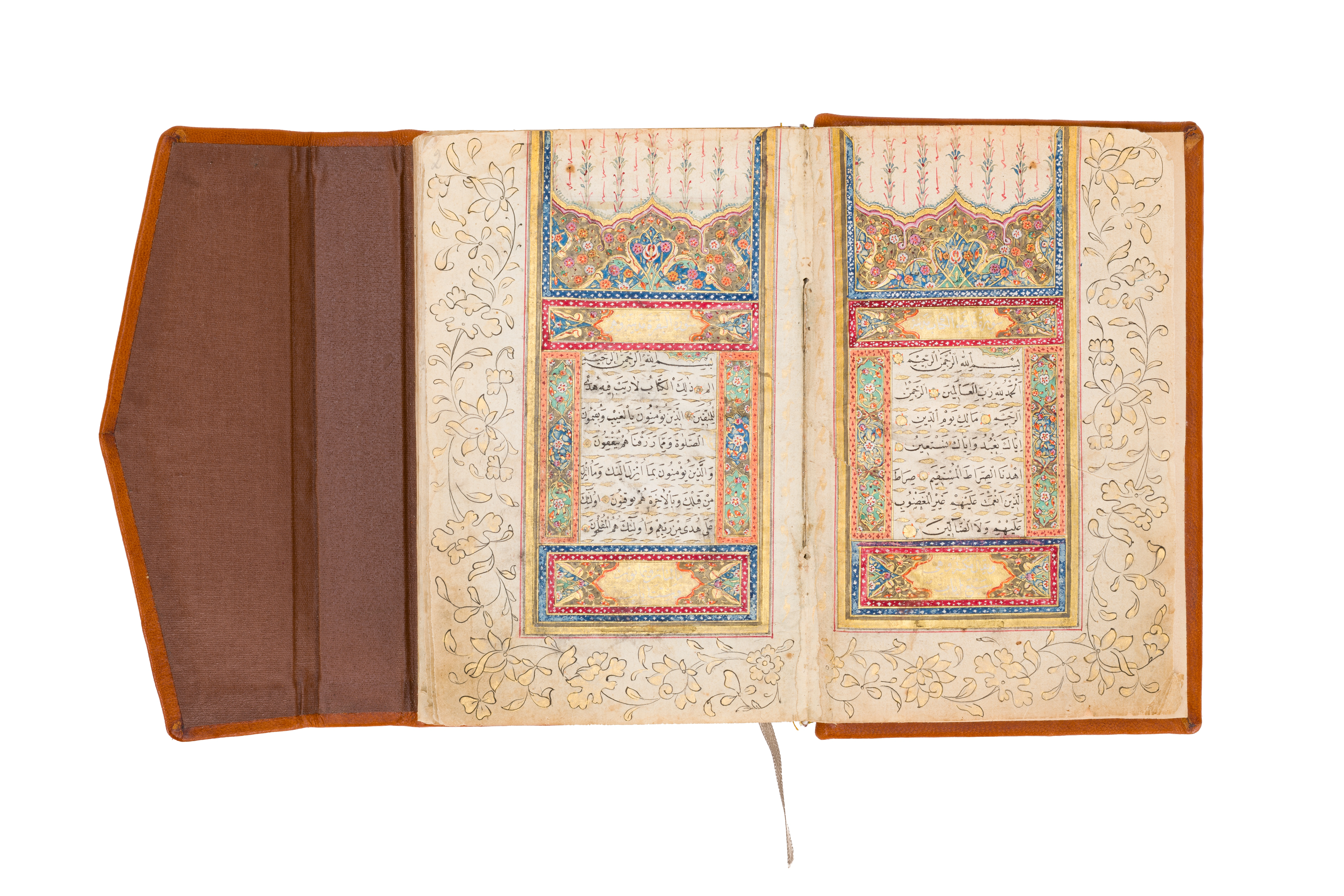
The Holy Qur’an
17th century CE. 19.5 × 12.5 cm. 293 folios. From the collection of the Center of Islamic Civilization in Uzbekistan, inv. No 00256
Audio guide
Description
The relatively small format of this Qur’anic manuscript indicates its practical function and suitable for personal reading and daily use. It is a compact 17th-century mushaf comprising 293 folios.
The text is written in naskh script, which by this period had become the fully standardized book hand of the Islamic world. The balanced proportions of the letters, the clear vocalization system, and the steady line rhythm ensure legibility and compositional clarity.
The decorative program combines a framed layout with floral ornamentation. Polychrome borders create visual balance between the textual field and the ornamental space. Unlike monumental codices, the artistic conception here is more intimate, intended for close and attentive reading.
The number of folios indicates a complete Qur’anic text and reflects the developed manuscript culture of the 17th century.
Within the exhibition section “The Spread of Islam in Central Asia,” this manuscript demonstrates how written tradition became integrated into everyday religious life, where the Qur’an functioned both as an object of art and as a companion of devotion.