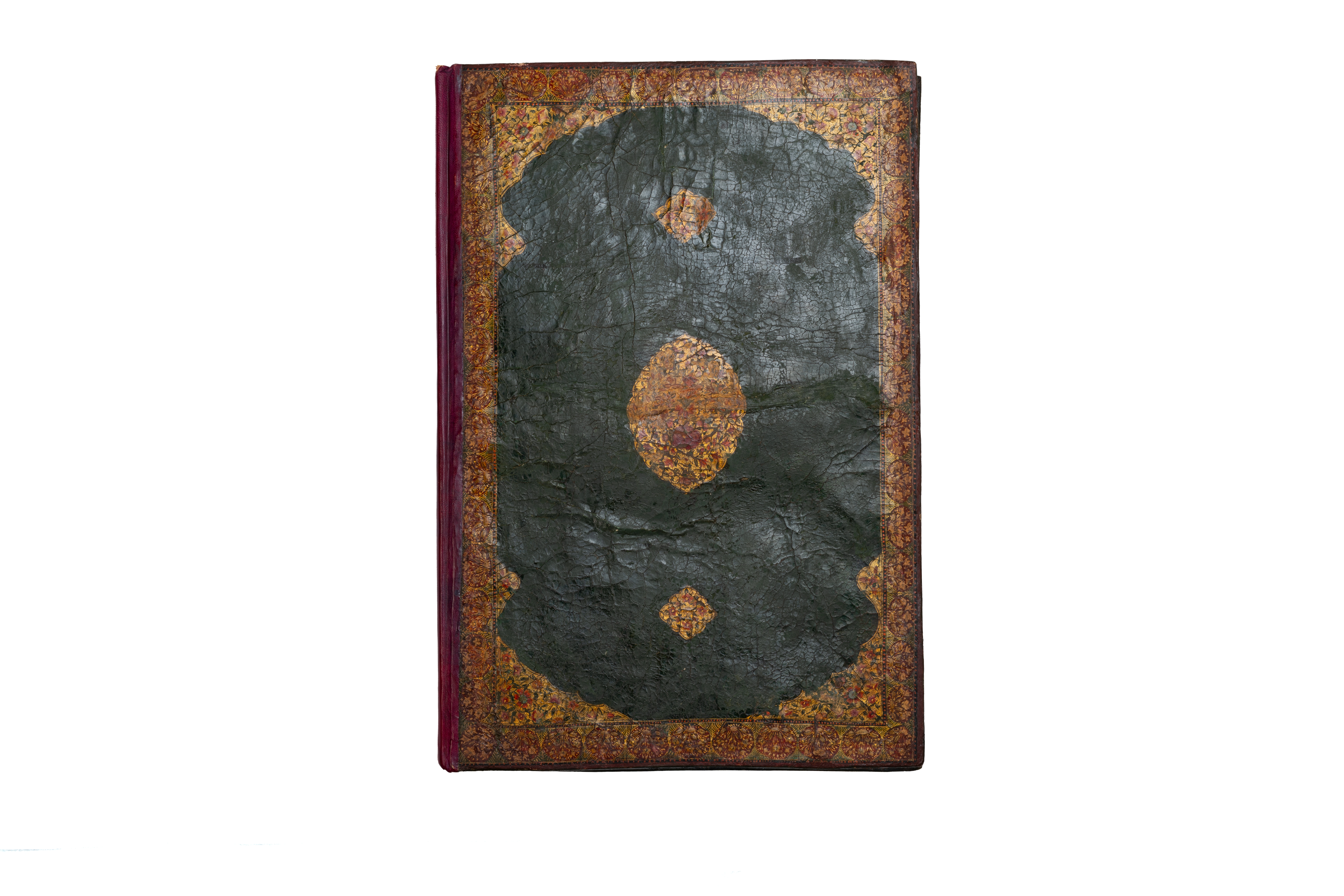
The Holy Qurʾan
17th century CE. 47.5 × 32.5 cm. 216 folios. From the collection of the Center of Islamic Civilization in Uzbekistan, inv. No 00258
Audio guide
Description
This is a large-format Qur’anic manuscript dated to the 17th century, comprising 216 folios. It is a complete codex produced within a well-established manuscript tradition of the Islamic world.
The text is written in naskh script, which by the 17th century had become the universally accepted standard for copying the Qur’an. The proportional clarity of the letterforms, the developed system of vocalization, and the even alignment of lines ensure legibility and visual stability on the page.
The format indicates a ceremonial function. The opening spread is framed by an elaborate polychrome border of vegetal and geometric ornament. Gilded cartouches and medallions articulate structural divisions and create a symmetrical composition.
The volume of 216 folios suggests a complete or nearly complete mushaf. The quality of the paper and the complexity of the decorative program reflect the professional level of the workshop in which it was produced.
Within the exhibition complex “The Spread of Islam in Central Asia,” this Qur’an illustrates the continuity and refinement of the naskh tradition in the later medieval period, uniting functional clarity with artistic elaboration.