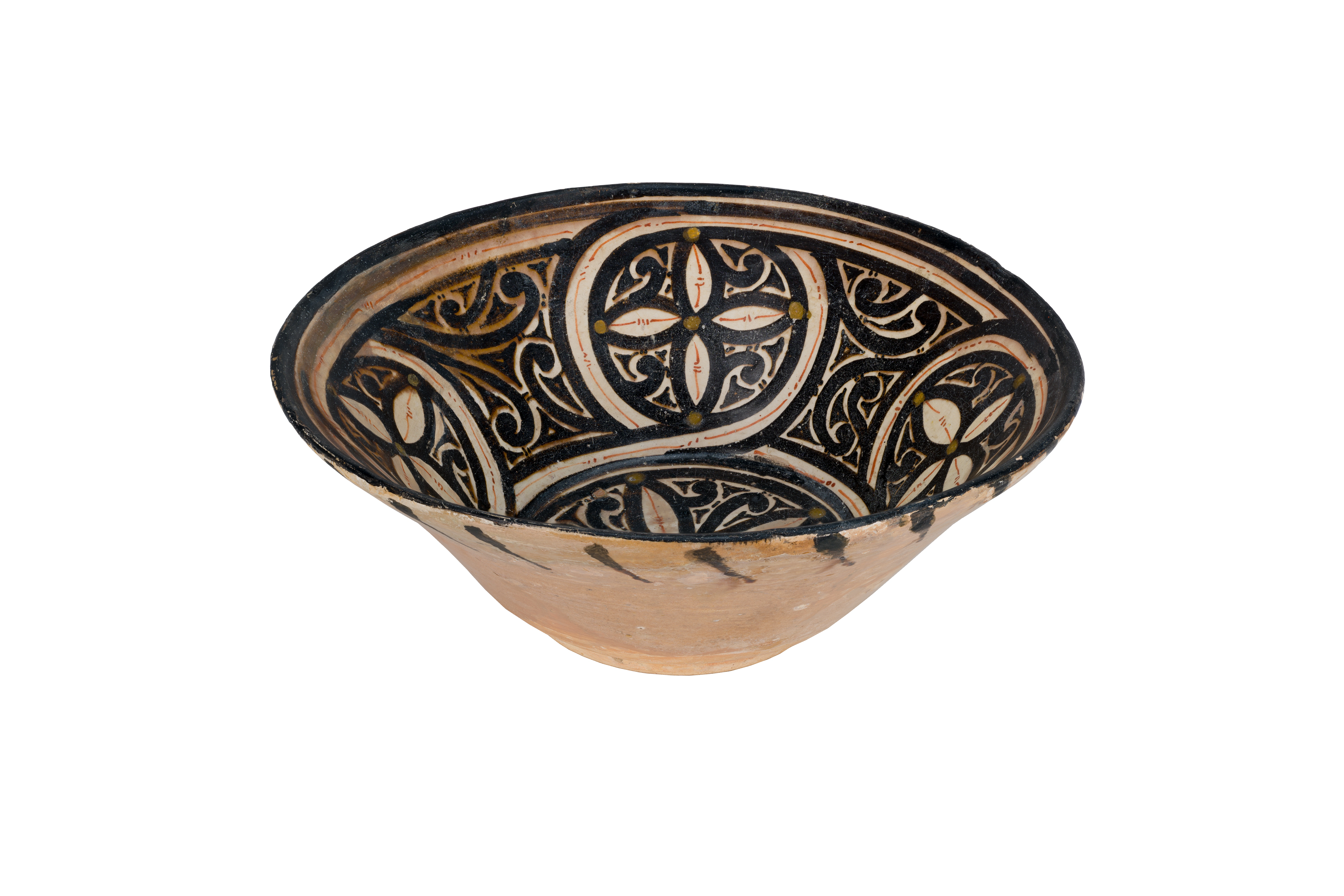
Bowl
Khwarazmshah period
8th–12th centuries CE
Khwarazm
Ceramic
8.5 × 22.6 cm
Audio guide
Description
This ceramic bowl dates to the 8th–12th centuries and was discovered in Kharazm. It may have been created in regions such as Central Asia, Iran, or Kharazm. In particular, ceramic art was highly developed in centers such as Samarkand, Nishapur, and Rey, where many works in this style were created. This bowl was made by hand, and thanks to the craftsman's skill, each decoration was executed in a particularly high style. This may indicate that it is intended not only for everyday needs, but also for festive or cultural celebrations. This vessel is decorated using dark brown and white colors, and the geometric and floral patterns on its interior are arranged in a traditional decorative style. Each of the four main circles inside the vessel is filled with a central closed floral ornament, and the spaces between these ornaments are filled with carved ornaments in the arabesque style. These forms are based on symmetry and rhythm, giving the decoration an aesthetic balance. Ornaments are interconnected by complexity, which indicates not only visual but also cultural significance. Such ornaments were widely used in Islamic art, and they were often used to express metaphysical meanings.