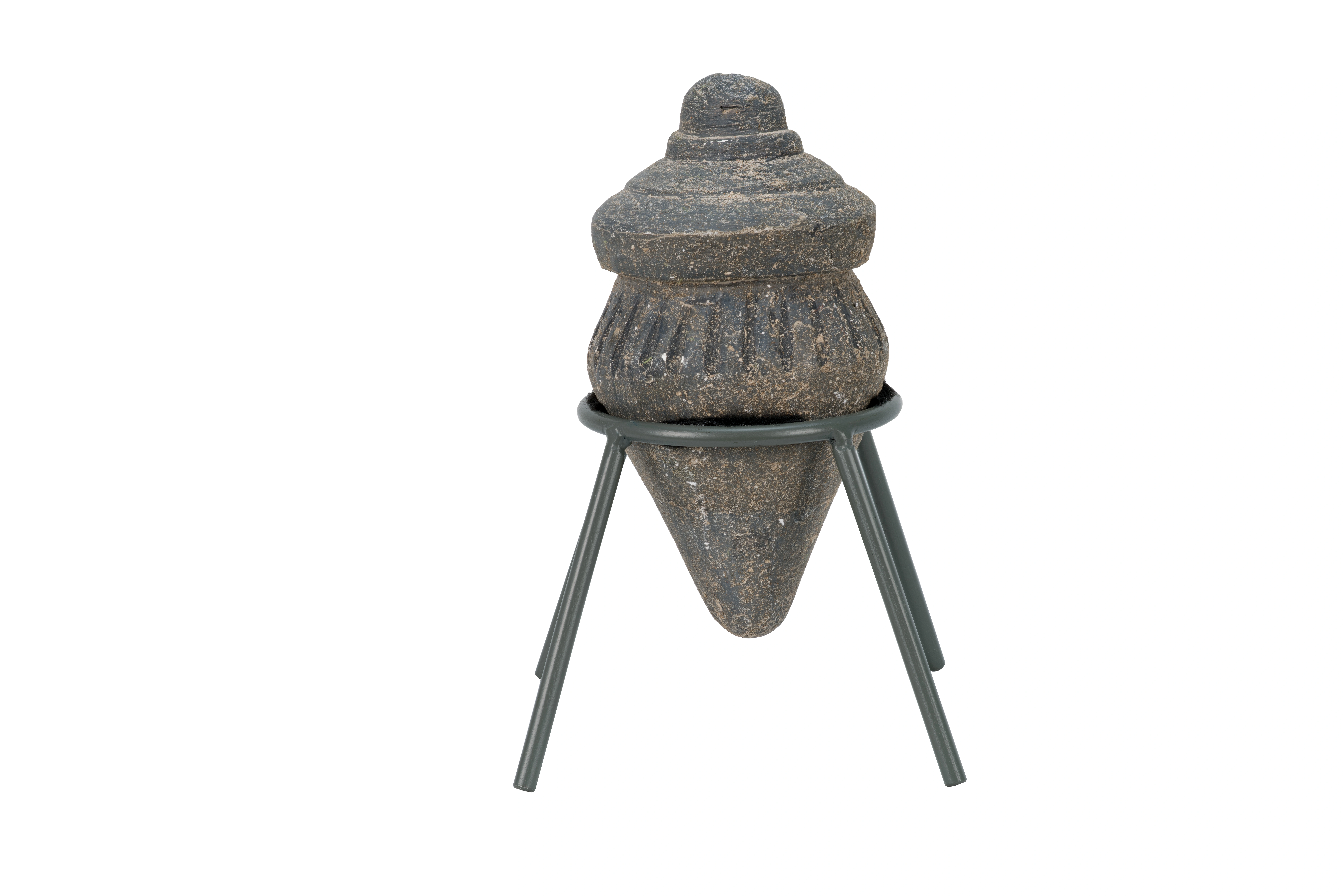
Sphero-conical Vessel for mercury
12th century CE. Surkhandarya. Ceramic. 16.1 × 8.5 cm
Audio guide
Description
Some archaeological objects raise more questions than answers. This vessel belongs to one of the most intriguing groups of medieval ceramics known as sphero-conical vessels.
Examples of this type have been found across Central Asia, Iran, and the Middle East. They are characterized by a rounded body, a narrow neck, and a pointed conical base. Their thick walls made them remarkably durable.
One widely accepted theory suggests that such vessels were used to store mercury. Because mercury is heavy and fluid, it required a strong, tightly sealed container for transport. The sphero-conical shape provided exactly that.
Other interpretations have also been proposed. Some scholars believe these vessels could have held perfumes, medicinal compounds, or precious oils. Another hypothesis links them to military use, suggesting they may have contained flammable substances.
The surface of this vessel is decorated with vertical grooves and stamped ornamental bands applied before firing. Such patterns were both decorative and structural.
Because of its pointed base, the vessel could not stand upright on a flat surface. Instead, it would have been placed in sand or held in a special stand, much like the one used in the museum display today.