Video available in: UZ
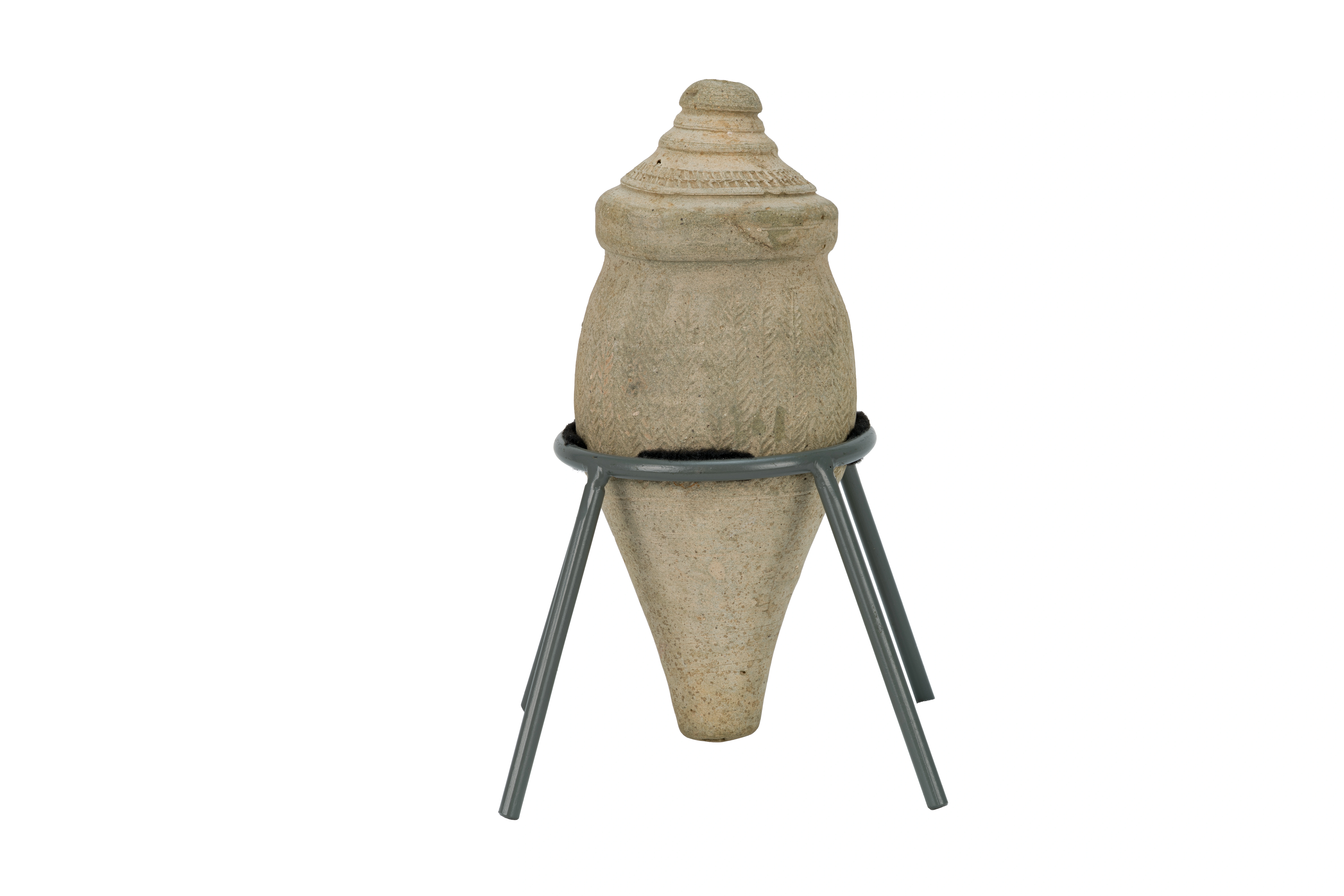
Sphero-conical Vessel for mercury
12th century CE. Surkhandarya. Ceramic. 19.1 × 8.2 cm
Audio guide
Description
This object belongs to one of the most intriguing categories of medieval ceramics known as a sphero-conical vessel.
Such vessels were widely used across Central Asia and the Middle East between the ninth and thirteenth centuries. They are recognizable by their distinctive shape: a rounded body, a narrow neck, and a pointed conical base. Their thick ceramic walls made them exceptionally durable.
For decades scholars debated their exact function. One widely accepted interpretation is that they were used for storing and transporting mercury. Because mercury is dense and mobile, it required a strong, tightly sealed container.
Other theories also exist. Some researchers suggest that sphero-conical vessels may have held perfumes, medicinal substances, or valuable oils. Another hypothesis proposes that they could have been filled with flammable mixtures and used as incendiary projectiles during medieval warfare.
The surface of this example is decorated with stamped geometric patterns applied to the clay before firing.
Its pointed base prevented the vessel from standing upright on a flat surface. Instead, it would have been placed in sand or supported by a special stand much like the one used in museum displays today.