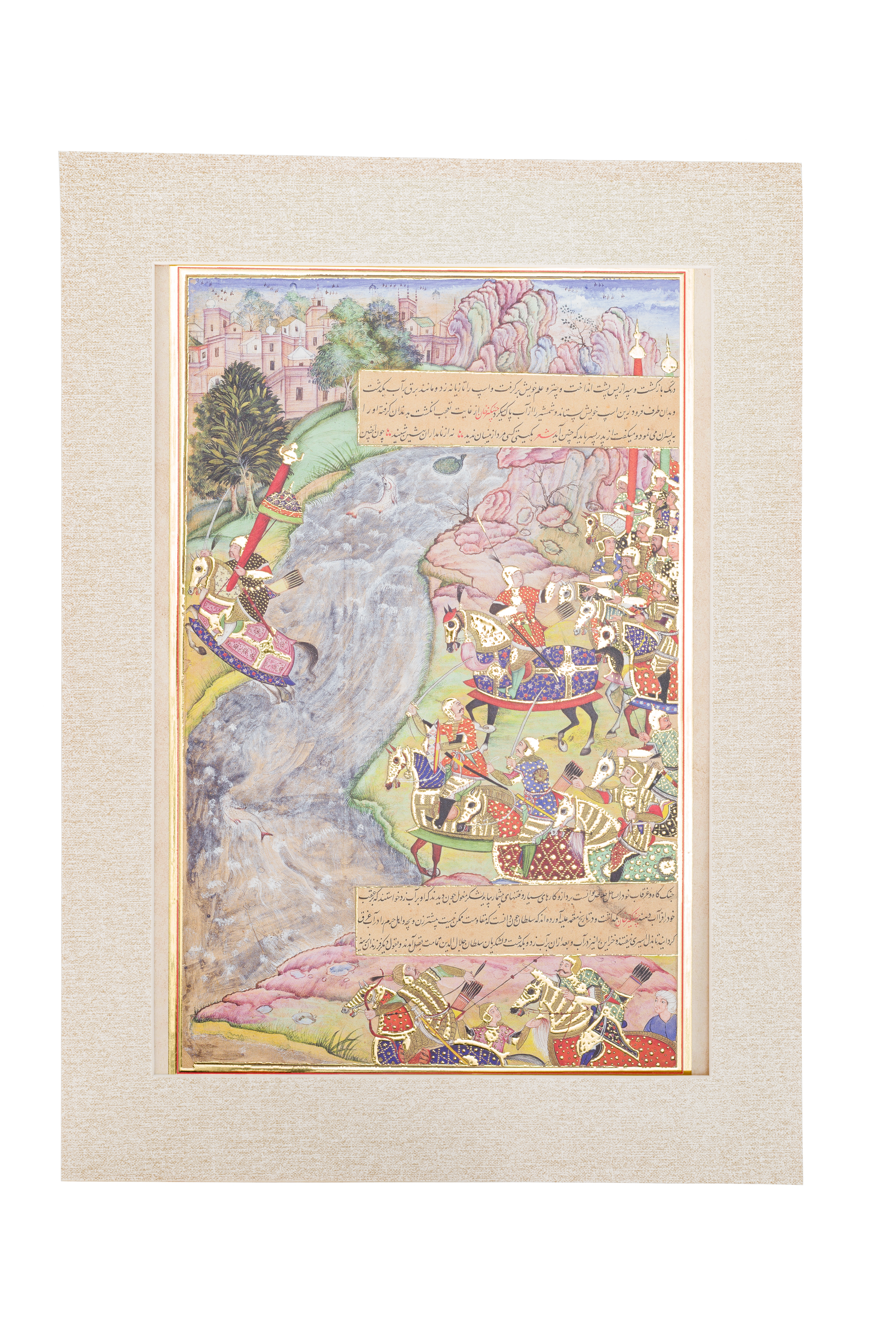
Folio from the manuscript “Chingizkhan-nama”
Dharam Das (Design), Banvari Khurd (Painter). Genghis Khan’s army pursuing Jalaluddin. 1596–1600 CE. India. 28.2 × 19.4 cm. British Museum, London
Audio guide
Description
This folio comes from the manuscript Genghiz Khan-nama, produced in India between 16th and 17th centuries. The scene depicts the pursuit of Jalal al-Din Khwarazmshah by the army of Genghiz Khan, one of the most dramatic episodes marking the end of the Khwarazmian state.
The miniature unfolds as a moving panorama. Horsemen surge toward a river that functions not only as a physical obstacle but as a symbolic boundary of fate. The tension in the riders’ postures and the rhythm of weapons convey urgency and inevitability. Landscape here is not passive; it actively shapes the narrative.
Significantly, this image was created centuries after the historical events it portrays. The history of Central Asia was also perceived as an important spiritual and political legacy during the Baburid dynasty. Such illustrations were tools for reflecting on power, legitimacy, and the consequences of resistance.
Within the exhibition complex devoted to the Khwarazmshahs, this page marks a turning point when the political and cultural landscape of Central Asia was irreversibly transformed by the Mongol conquest.