Video available in: UZ
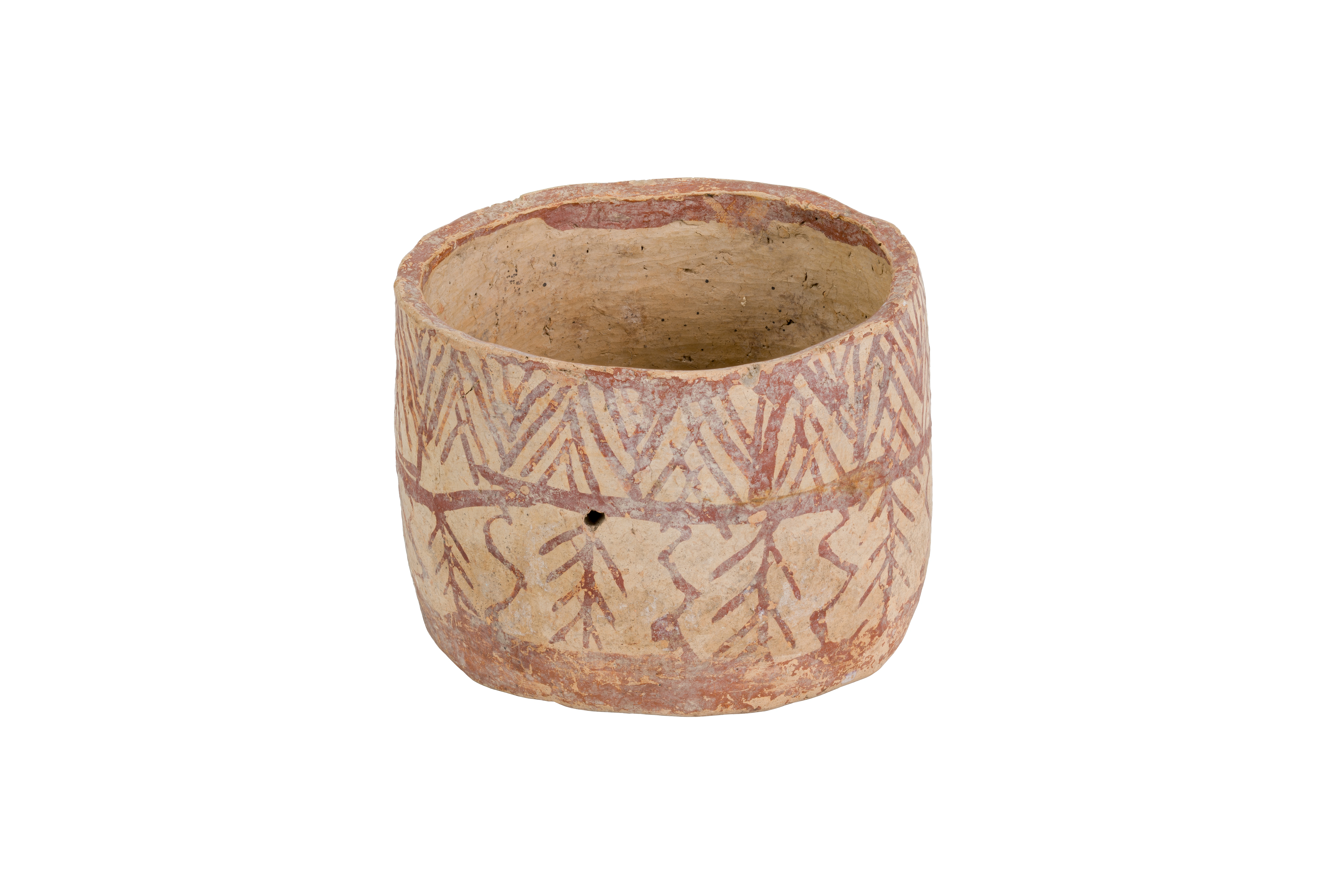
Cylindrical Bowl
4th–1st centuries BCE. Fergana. Ceramic. 9 × 11.9 cm
Audio guide
Description
This cylindrical bowl from the Fergana Valley dates to the 4th–1st centuries BCE, a period marked by active cultural interaction in Central Asia.
Its form is simple and well balanced, with straight walls and a stable base. Such bowls were used in daily life for drinking and serving food, and may also have functioned in ritual contexts.
A geometric frieze of diagonal and zigzag lines decorates the upper band, while stylized vegetal motifs appear below. The design was applied with mineral pigments over a light slip-coated surface.
The vessel was formed on a fast potter’s wheel and subsequently covered with a thin layer of slip to create a smooth ground. After painting, it was fired in a kiln under controlled temperature conditions, ensuring the durability of both the fabric and the decoration.
This bowl illustrates the established ceramic traditions of the Fergana Valley prior to the formalization of long-distance trade routes later known as the Silk Roads.