Video available in: UZ
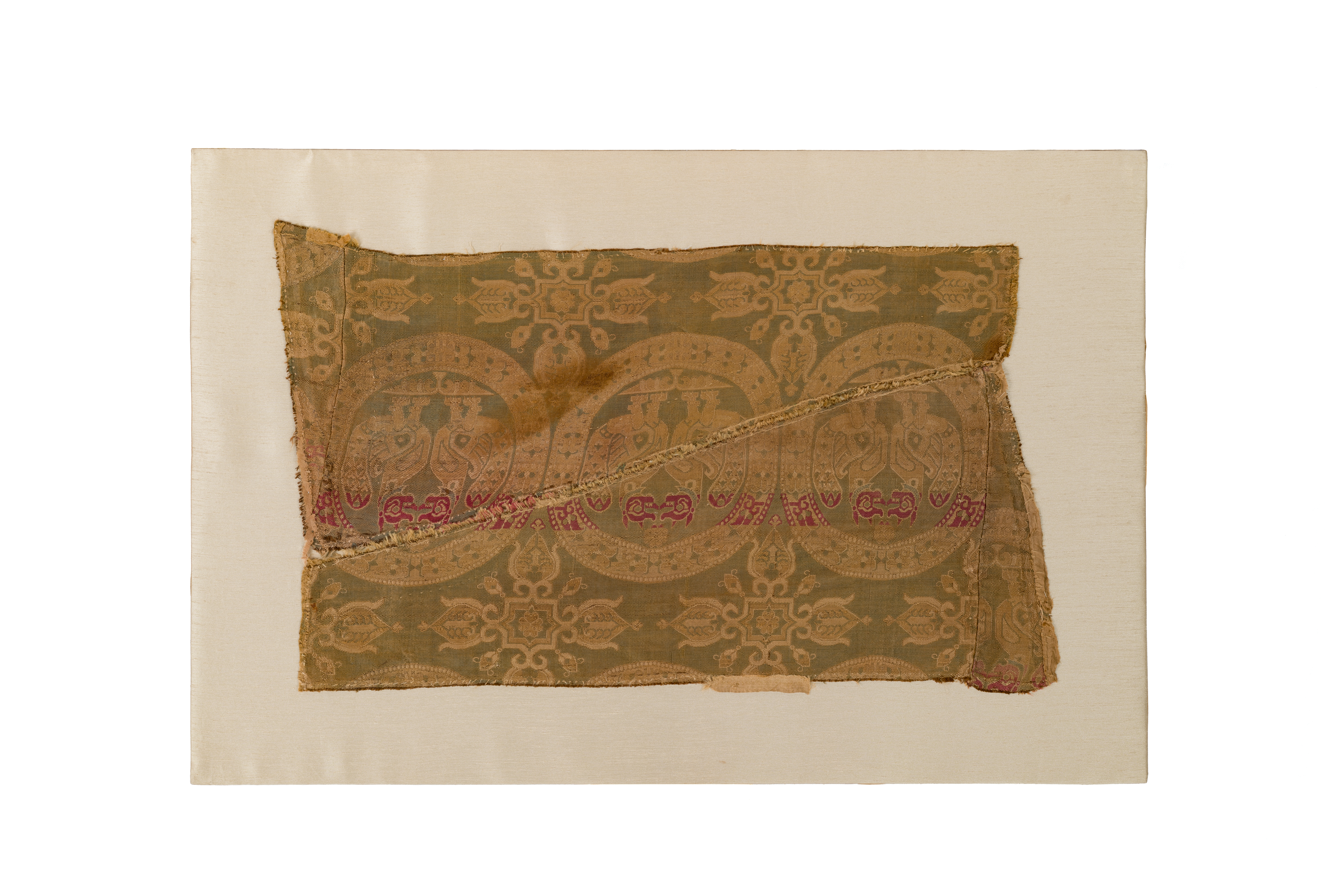
Fabric Fragment with a Pair of Mythological Birds
7th–9th centuries CE. Sogd. Silk. 30 × 48.3 cm
Audio guide
Description
You are looking at a fragment of Sogdian silk dating to the 7th–9th centuries CE, a textile that functioned not merely as a luxury fabric but also as a cultural emblem of the Silk Roads.
At the center appears a pair of mythical birds facing one another. Such “affronted” compositions are commonly interpreted as symbols of harmony, prosperity, and divine glory, known in Iranian tradition as farn. The birds often flank a stylized Tree of Life, associated with concepts of cosmic order.
The circular medallions framed by a distinctive “pearl roundel” border are characteristic of early medieval Sogdian design. Although the motif originated in Central Asia, Sogdian workshops adapted and disseminated it widely, making it a recognizable element of transcontinental luxury textiles.
The fabric was woven in the samite technique, a complex weft-faced compound twill. This advanced method allowed for a dense textile structure and vivid patterning. Comparable fabrics have been discovered across a vast geographic range, from China and Japan to Byzantium and Western Europe, including church treasuries.
This fragment attests to Sogdiana’s role not only as a commercial intermediary but also as an important artistic center within the interconnected world of early medieval Eurasia.