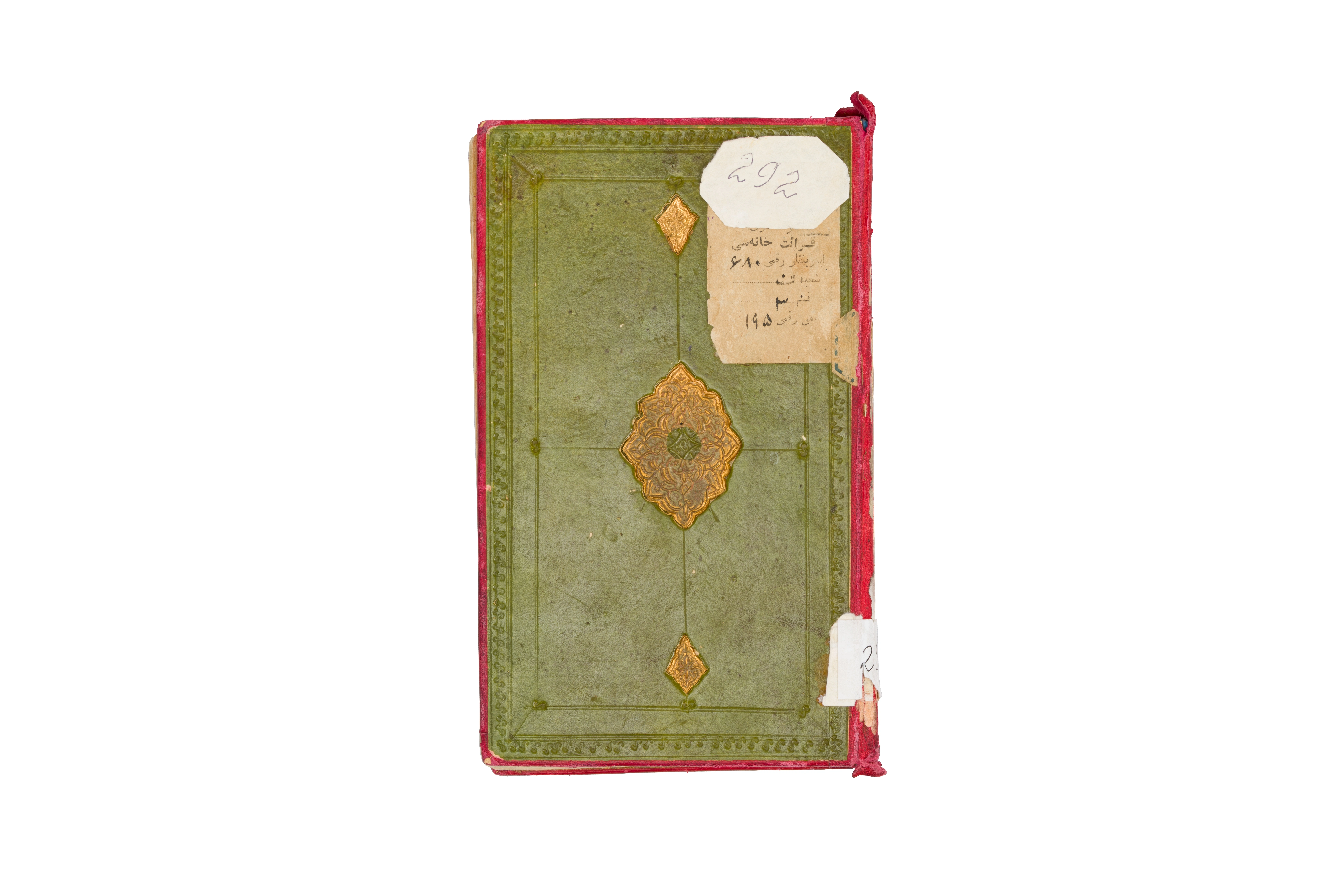
“Letter to Amir Haydar”
Muhammad Riza Balkhi. Second half of the 19th century. Bukhara. Persian. Nastaliq script. Kokand paper. 23.7 × 15 cm. Manuscript of the Institute of Oriental Studies of the Academy of Sciences of the Republic of Uzbekistan, inv. No. 292/I
Description
A green binding with gilded medallions conceals not a ceremonial poem, but a letter. On the opening, the manuscript has a different character: calm nastaʿliq script, broad margins, a few red highlights, and an almost administrative restraint.
The Letter to Amir Haydar is connected with the name of Muhammad Riza Balkhi and the written culture of Bukhara in the second half of the nineteenth century. Amir Haydar himself ruled Bukhara earlier, in the early nineteenth century. For that reason, this is probably not a current letter, but a preserved copy or model of correspondence, important for chancery memory.
Such texts belonged to the art of insha – the composition of official and learned letters in Persian. What mattered was not only information, but form: the order of address, formulas of respect, and the precision of script.
For the Uzbek Khanates section, this manuscript is valuable as a trace of Bukhara’s administrative culture. It shows that authority rested not only on the ruler’s decisions, but also on writing, archives, memory, and the language of the chancery.