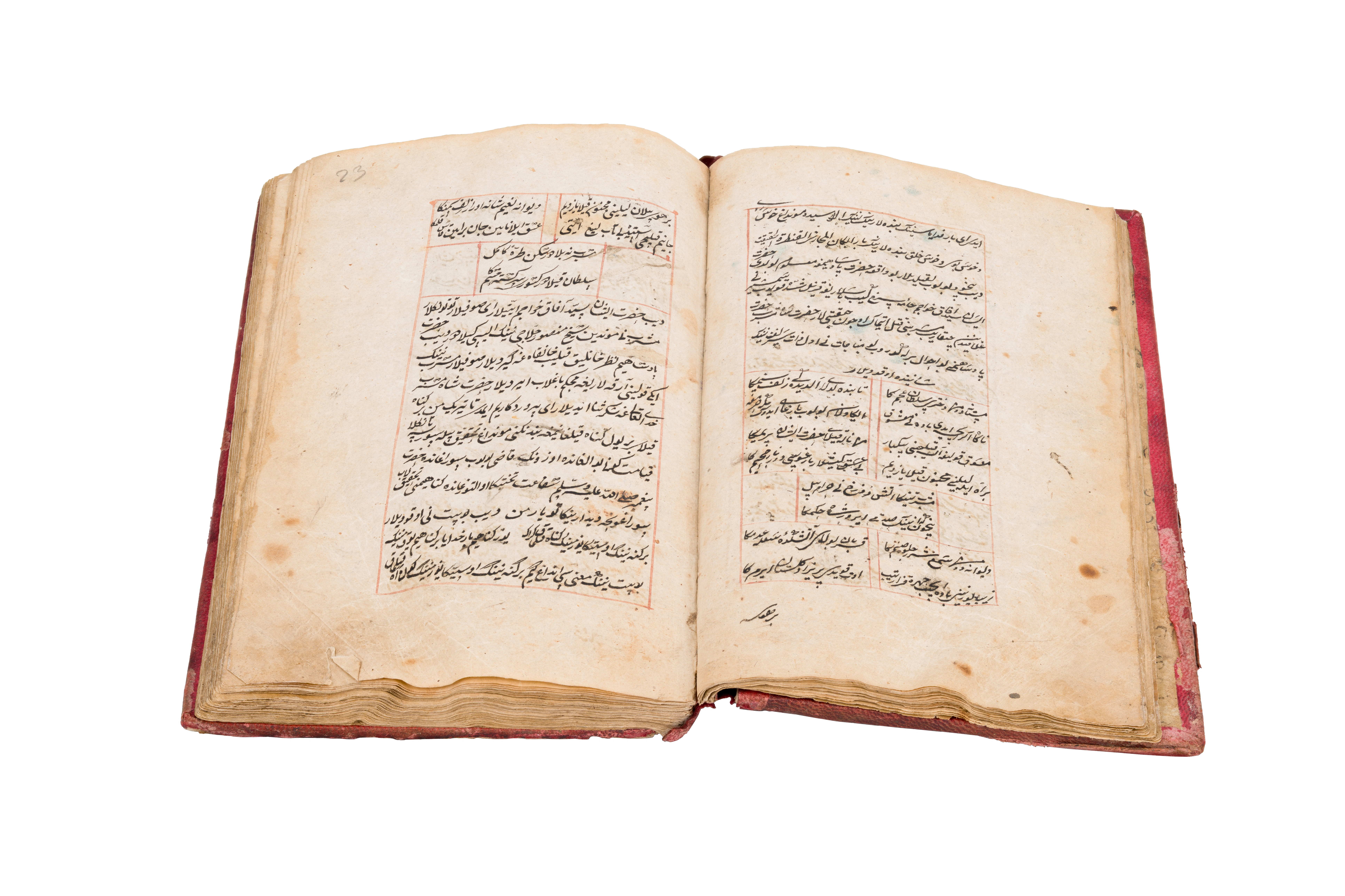
Qissai Mashrab
17th century. Central Asia. Uzbek. Nastaliq script. 14.5 × 2.5 sm. Manuscript of the Institute of Oriental Studies of the Academy of Sciences of the Republic of Uzbekistan, inv. No. 11836
Description
On this opening, the text is enclosed within thin red frames, while the lines are arranged in compact rectangular blocks. The small format of the manuscript and the dense structure of the page immediately suggest a book intended for constant carrying and frequent reading. Such manuscripts often accompanied wandering dervishes, students, and folk performers.
This is Qissai Mashrab – a narrative about the life and spiritual journeys of Boborahim Mashrab, one of Central Asia’s most celebrated Sufi poets. In this work, historical events are interwoven with legends, poetry, and stories of miracles.
Mashrab became famous as a poet who openly criticized hypocrisy and outward displays of religiosity. He insisted that true faith arises not from ritual formality, but from inner love for God. For this reason, his poetry disturbed part of the official religious establishment, while gaining immense popularity among ordinary people.
For centuries, Qissai Mashrab was read and sung at popular gatherings throughout Central Asia. This manuscript preserves the memory of a Sufi tradition in which spiritual freedom became a form of moral resistance.