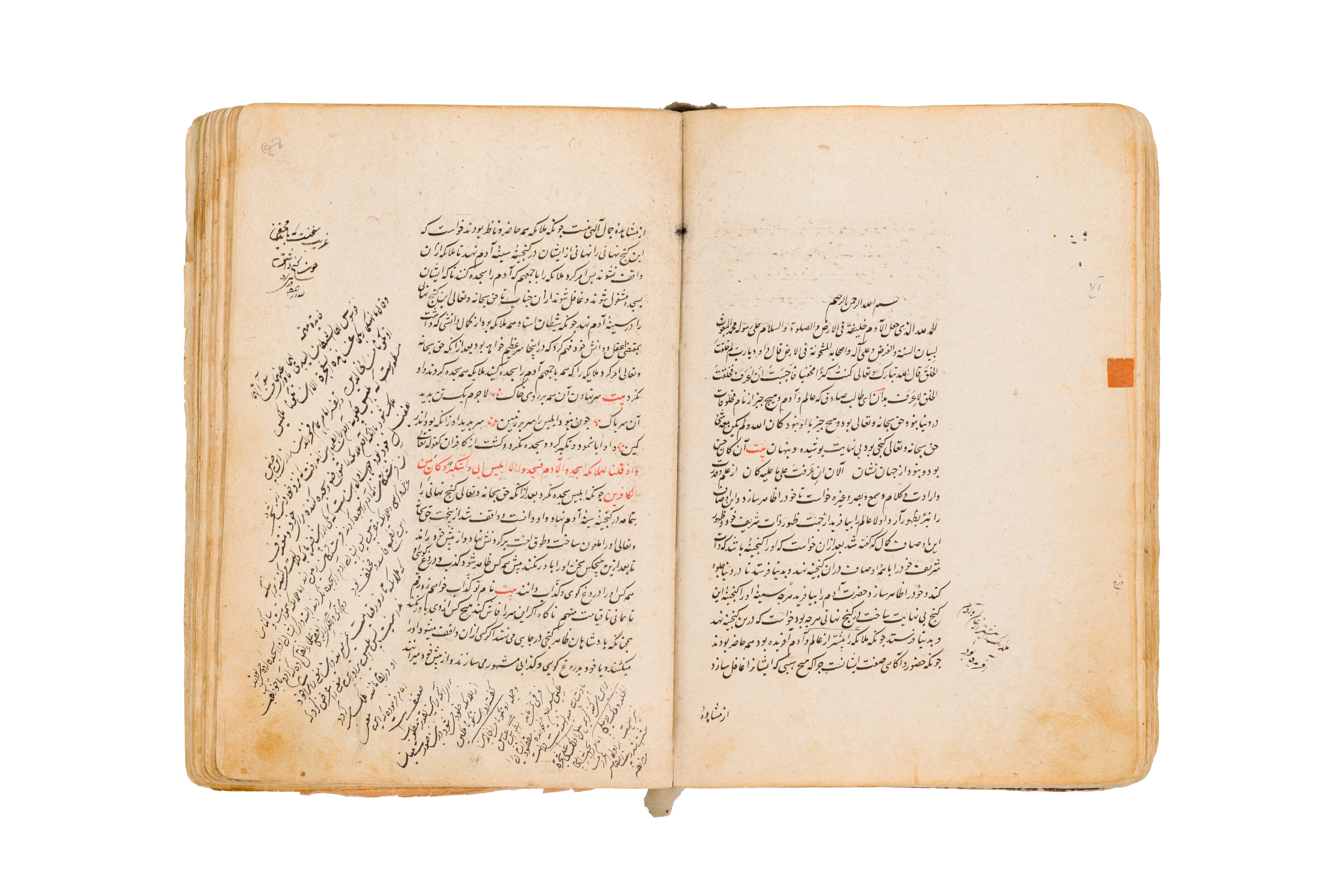
“Treatise on the Baburids”
Sayyid Ahmad ibn Jalaluddin Kosani (Makhdumi A'zam). Calligr: Sayyid Muhammad ibn Mir Jaloluddin Buxoriy. Copied in 1589. Central Asia. Persian. Nastaliq script. Oriental paper. 17 × 24.5 cm. Manuscript of the Institute of Oriental Studies, Academy of Sciences of Uzbekistan
Description
This manuscript is Risolayi Boburiya, a work by Sayyid Ahmad ibn Jalal al-Din Kasani, known as Makhdum-i A‘zam. It was copied in Central Asia in 1589 by the calligrapher Sayyid Muhammad ibn Mir Jalal al-Din Bukhari. The author belonged to the circle of major Naqshbandi masters, a Sufi path deeply connected with the spiritual and political life of Mawarannahr. In the treatise, Babur’s name becomes a starting point for reflection on rulership, responsibility, inner discipline, and moral order. The manuscript is written in Persian in clear nastaliq script; red rubrication guides the reading of key sections, while numerous marginal notes show that the text was not simply preserved in silence: it was studied, explained, and transmitted. In the Babur sector, this manuscript reveals a less obvious side of the Second Renaissance – not only campaigns and dynasties, but also the spiritual ideas that accompanied power. This perspective helps us see the Baburids as heirs to Central Asian book culture, where rule was imagined together with guidance and knowledge. Here, the memory of Babur becomes part of Central Asia’s living intellectual tradition.