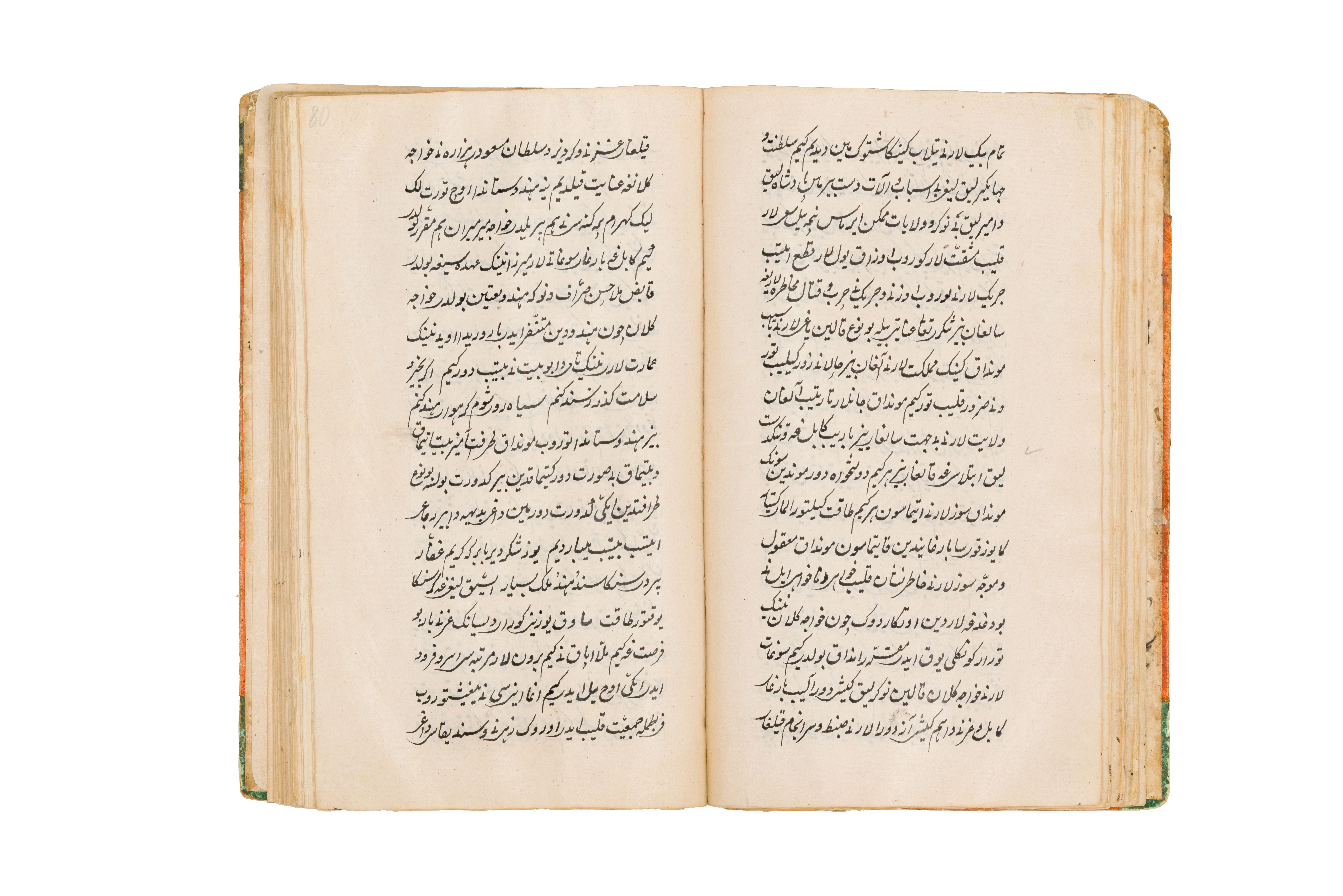
“Waqi‘at-i Zahir al-Din Muhammad Babur Padshah” (Baburnama)
Zahir al-Din Muhammad Babur. Translator: Taghay Murad Qarluqi Khatlani Baljuwani-Akhund. Copied in 1912. Central Asia. Oriental paper. Persian. Nastaliq script. 17.5 × 30.5 cm. Manuscript of the Institute of Oriental Studies, Academy of Sciences of Uzbekistan
Description
This manuscript presents a Persian translation of the Baburnama – Vaqi‘at-i Zahir al-Din Muhammad Babur Padshah. It was copied in Central Asia in 1912, when manuscript books already coexisted with print but still retained high cultural status. Babur’s original memoirs were written in Turki, or Chagatai; the Persian version opened the text to a wider scholarly and courtly audience across the Islamic world. The translator’s name – Taghay Murad Qarluqiy Khatlani Baljuvani-Akhund – shows that Babur’s legacy continued to be read, translated, and carefully transmitted in the region centuries later. This copy preserves a dark leather binding with gilded medallions, Eastern paper, and even nasta‘liq script. The Baburnama combines political chronicle, personal testimony, geographical observation, and descriptions of life in Ferghana, Kabul, and India. In the Babur sector, this manuscript appears as a late link in a larger tradition: the memory of a ruler from Mawarannahr continued to live between Turkic and Persian languages. The Second Renaissance is therefore revealed not as a completed era, but as a long transmission of text, authority, and knowledge.