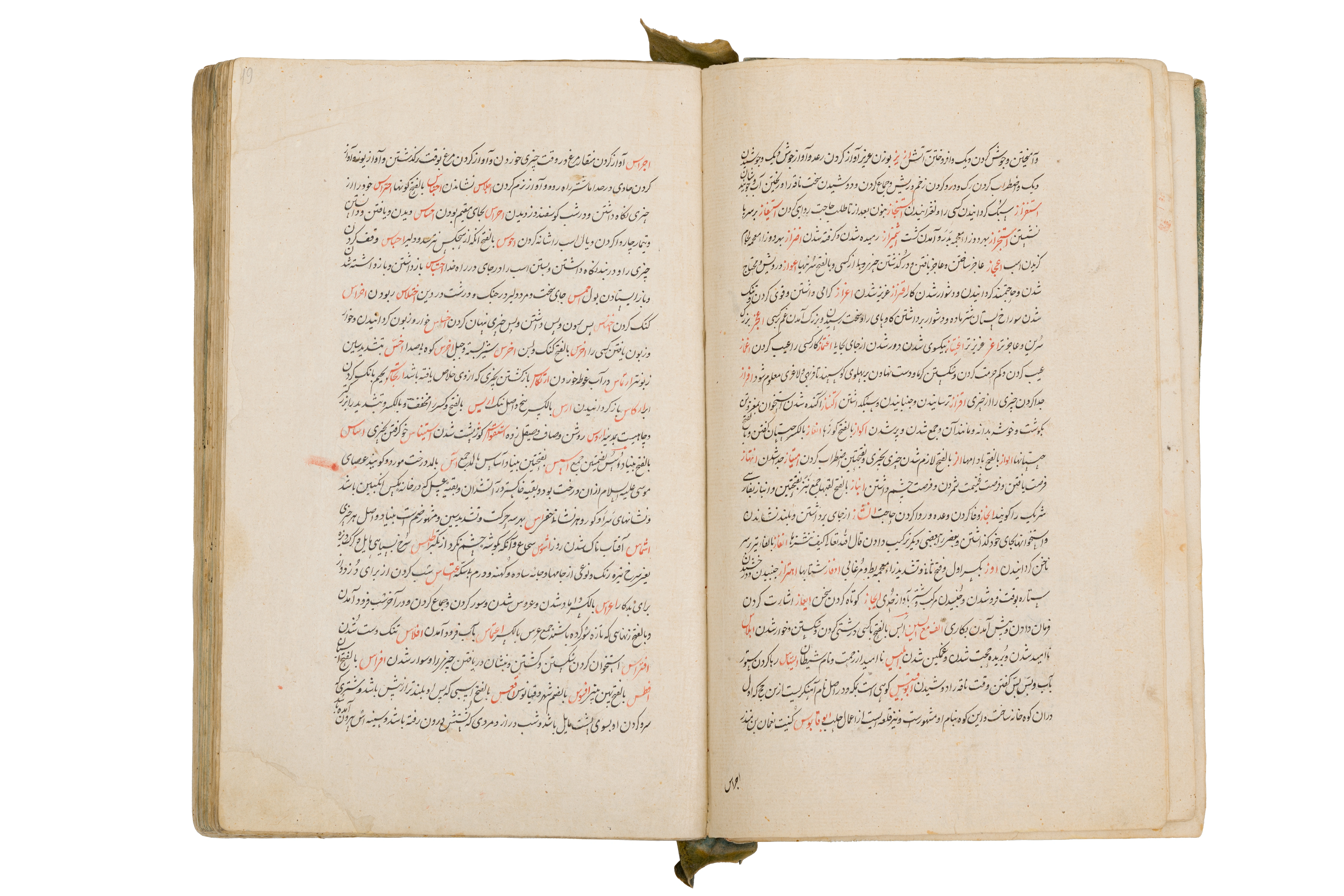
“Baburnama”
Zahir al-Din Muhammad Babur. Calligrapher: Muhammad Vafa ibn Mirza Fayzullah. Copied in 1908. Central Asia. Turkic. Nastalik script. Oriental paper. 15 × 26 cm. Manuscript of the Institute of Oriental Studies, Academy of Sciences of Uzbekistan
Description
Before us is a manuscript copy of the Baburnama, the autobiographical work of Zahir al-Din Muhammad Babur, copied in Central Asia in 1908. The book was produced in the age of print, yet it preserves the form of a classical manuscript: Eastern paper, nastaliq script, red rubrication, and a simple blue-green binding marked by long use. Babur’s original work was written in Turki. It combines the ruler’s personal memories, political chronicle, descriptions of Ferghana, Kabul, and India, and observations on cities, gardens, plants, climate, people, and courtly culture. For the Babur sector, this late copy is especially significant: it shows that the legacy of the founder of the Baburid dynasty continued to live in Central Asian manuscript tradition four centuries after his campaigns. In the context of the Second Renaissance of Islamic civilization, the Baburnama reveals the movement of knowledge, language, and memory from Mawarannahr to India and back again. It is not only a historical text, but a living form of Babur’s cultural return to the homeland of his word. In these pages, the late scribe preserved not only the text, but also the rhythm of Central Asian book culture.