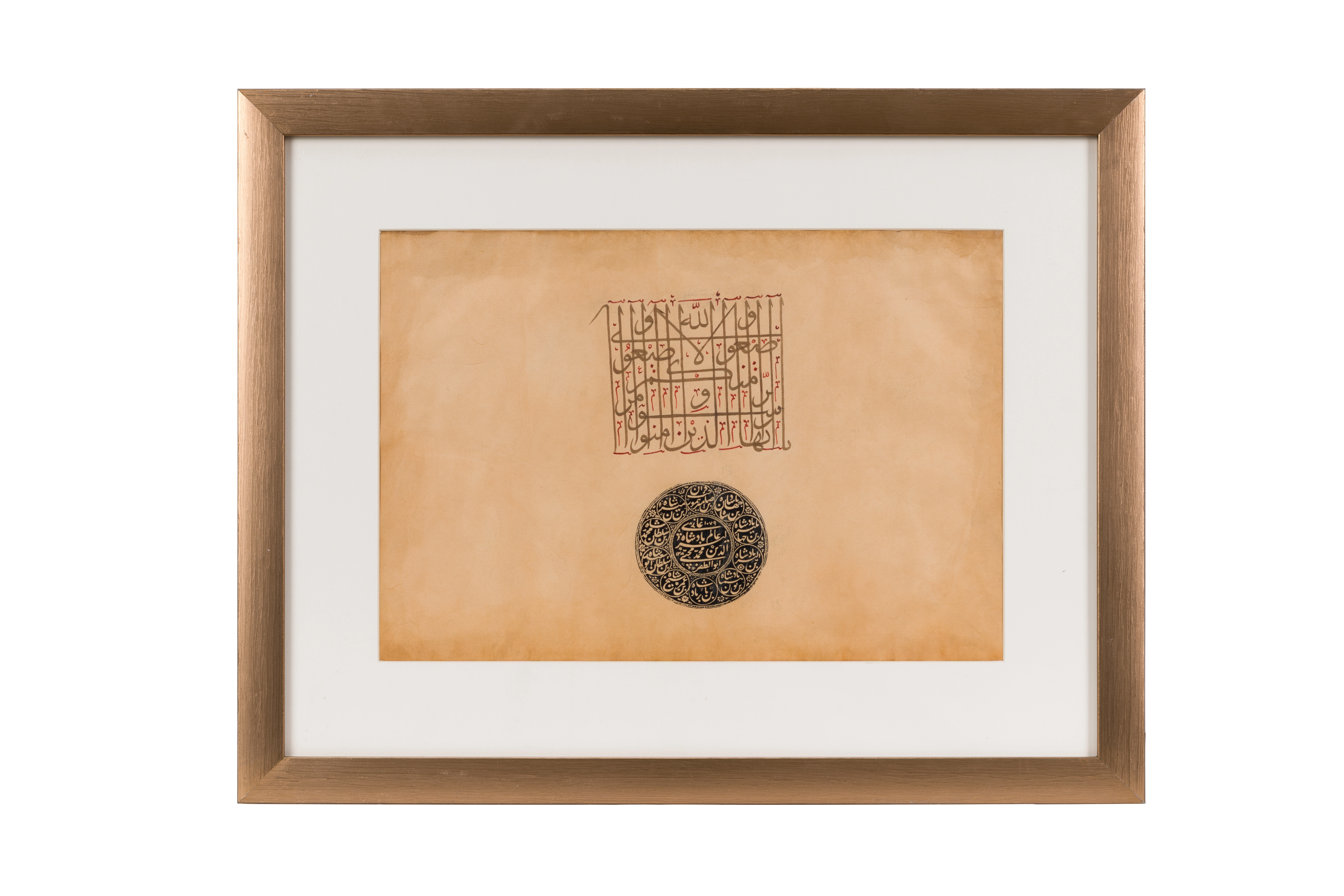
Aurangzeb Seal
Baburid Period. 16th century. India. Papper. Diameter: 5.4 cm
Description
Before us is a sheet bearing an impression of a seal associated with the Baburid emperor Aurangzeb Alamgir, together with a square calligraphic composition. The circular seal is arranged as a dynastic scheme: the ruler’s name is placed at the center, while the outer ring presents a chain of ancestors leading back to Babur and, beyond him, to Amir Timur. In the Baburid chancery, such a mark was not merely a signature, but an assertion of legitimate authority. Beside it is a geometric textual square: the straight lines of script turn a sacred formula into a disciplined architectural pattern. It recalls the decoration of madrasas, mosques, and mausoleums in Samarkand, Bukhara, and Herat, where the written word became part of space itself. This object is especially meaningful in the Babur sector: it shows how the Central Asian idea of dynastic legitimacy continued to operate in seventeenth-century India. Its restrained composition speaks the language of bureaucracy, faith, and artistic calculation, joining a state document to the visual culture of the Islamic world. On a single sheet, authority, ancestral memory, and the art of writing converge; this is why the seal is perceived here as a document of history, not merely as a mark on paper.